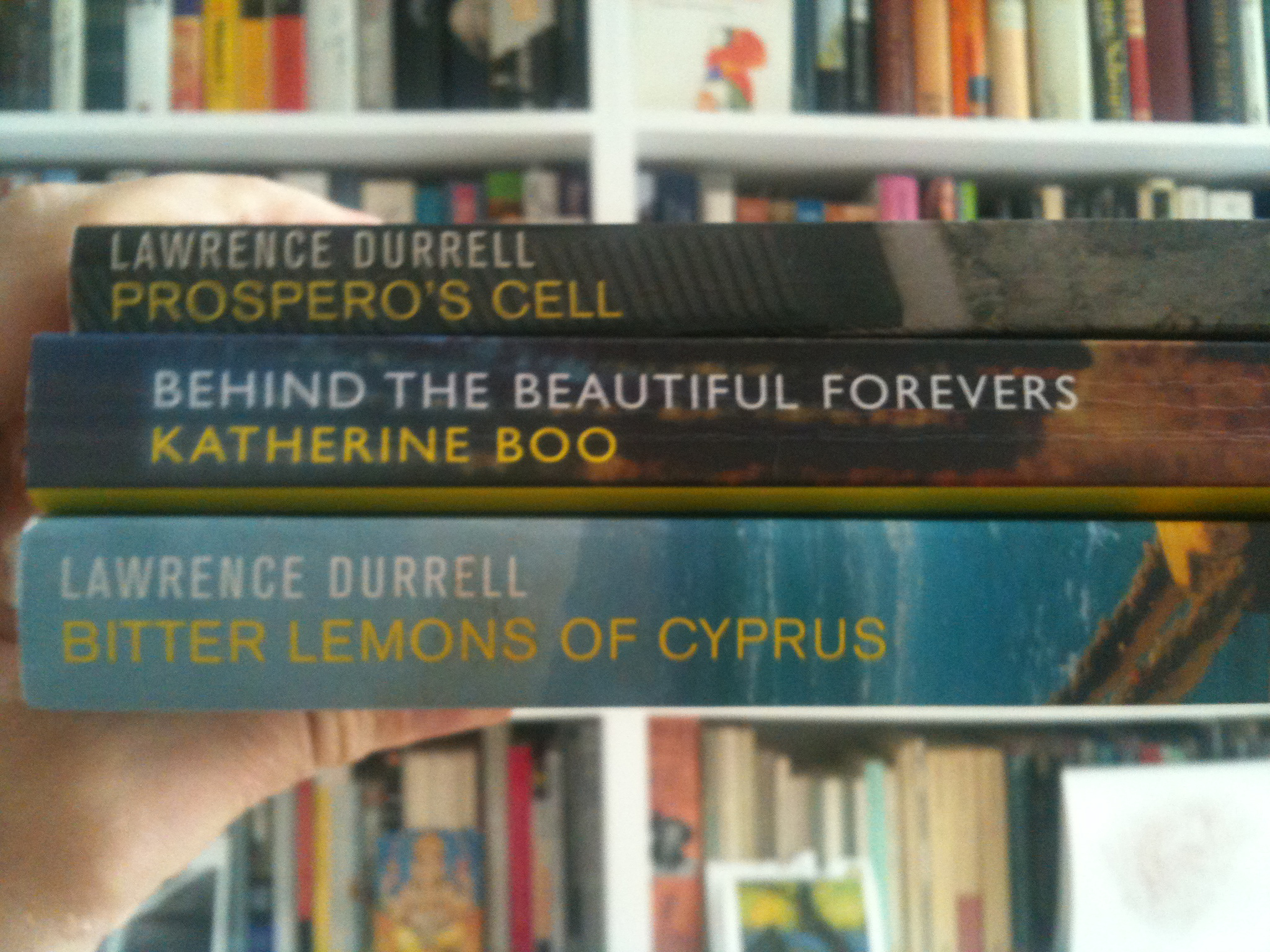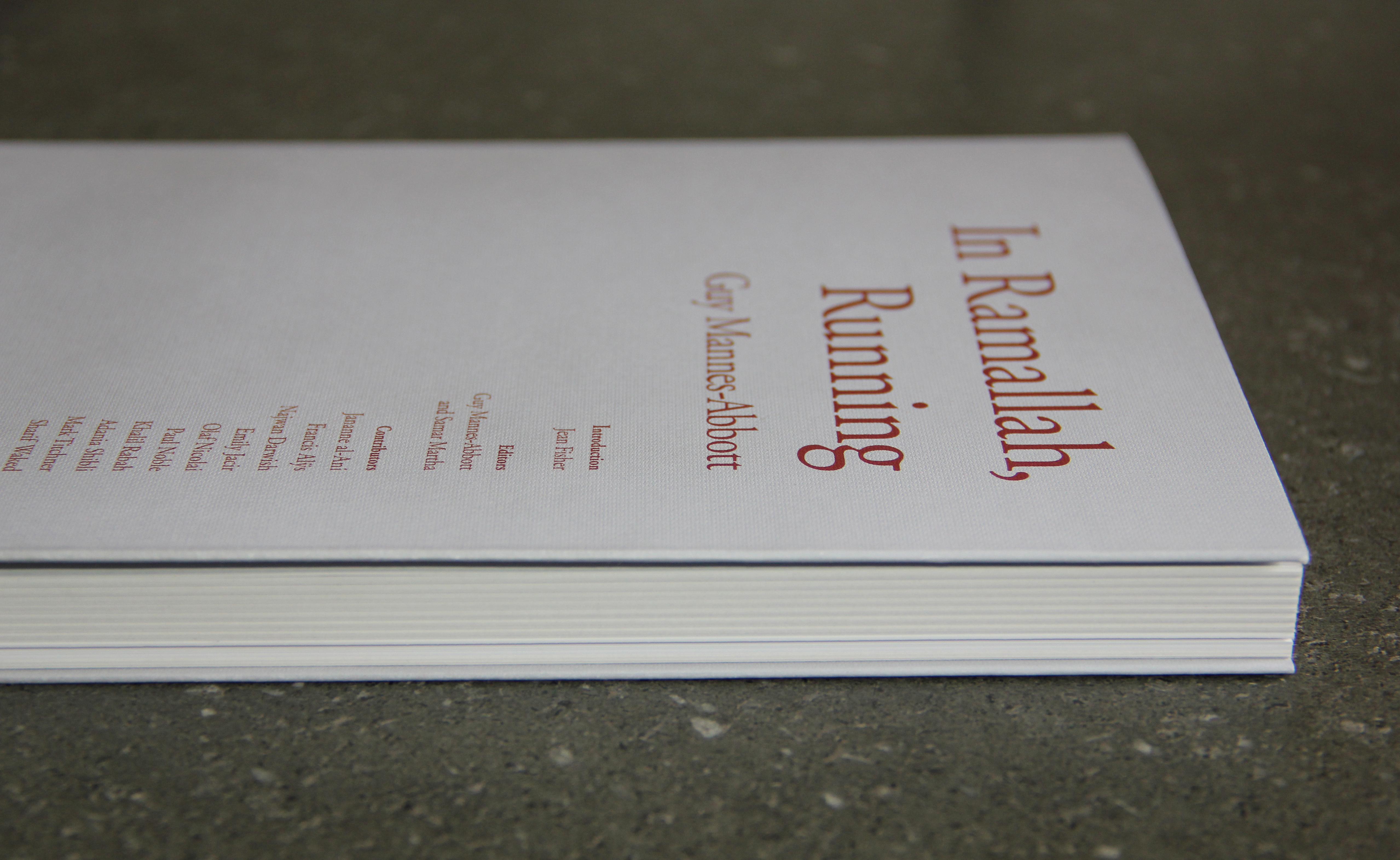
on ordering a copy of ‘in ramallah, running’ at the fruit store

In Ramallah, Running is now available to buy directly using Paypal. Each book will be signed and sent using 1st class Royal Mail by land or by Airmail using their territorial distinctions.

Please note that books can only be posted individually and that different shipping rates apply; UK, Europe, World! Please send queries through links on the About page here or Contacts page on my website.

Direct orders are warmly appreciated by author and ArtSchool Palestine and guaranteed to make the world a better place for all! Thank you in anticipation. News on launch-related events very soon…

on katherine boo’s beyond the beautiful forevers; spiking myth of india’s inpenetrability

“Katherine Boo’s debut about the vertiginousness of existence in a “Mumbai slum” is the antidote to mainstream books and films on the subject from the English-speaking world.”

Behind the Beautiful Forevers, By Katherine Boo.

Portobello, £14.99

GUY MANNES-ABBOTT

on the publication date for in ramallah, running, july 26th 2012

In Ramallah, Running by Guy Mannes-Abbott – July 26 2012

A brief word to celebrate the release of my book at last!

I’m attaching a copy of the Press Release which went out today with details about the book and its contents as well as contacts for review copies and further information.

In Ramallah, Running by Guy Mannes-Abbott | Press Release July 2012

I will update with news as well as details about a launch we will be having in early September, along with other readings, launch-related events, discussions and festival appearances in London, the UK and beyond.

More soon…

‘i am running in ramallah and it is painful…’ in manifesta journal #14 online & at genk

I am running in Ramallah and it is in audio in the current issue of Manifesta Journal #14 which you can read online here, download the complete pdf here, or go straight to the Translated By pages here. Scroll down to where it says ‘You pick a random number’ and 3, etc., and listen to the audio of my excerpt. All this running makes it a bit less painful -and In Ramallah, Running proper will be here soon!

Do have a look at MJ14 edited by Rasha Salti et al and with some great sections; conversation with Naeem Mohaimen, and  one on Joana Hadjithomas and Khalil Joreige’s Lebanese Rocket Society, the main monument of which stands today in a public square in downtown Sharjah -a SAF commission from 2010’s Biennial. Manifesta as such kicks off in Genk, Belgium this year of course; end of May slash start of June. Be there!

‘i am running in ramallah and it is painful…’ at SALT galata 06.04.12-08.07.12

Translated By in a new configuration and new location. I’ve not made it yet but hope I might. There is also a new version of the book, edited by Shumon, Charles and Suna Kafadar and designed by Zak. I’ve not seen it yet, etc.!

Meanwhile, In Ramallah, Running has been painful too, but advances are promised by the publisher very soon now and I will of course share confirmed publication and other dates when I have them. Meanwhile, very good bound proofs are available for review and related purposes. Contacts are here in the pdf button at the top. Be in touch!

notes from a meeting, artists on the frontier; resident or nomad? [day two pt2]

Sejla Kameric 1395 Days on the Frontier Photo G Mannes-Abbott

CLICK on image to link to SAF & more images or read on below …


Sama Alshaibi moderated a panel on Artists as Nomads, describing herself as the least “nomadic artist on the panel, relatively speaking,” secure in a US Professorship. Basma Alsharif, a Palestinian who “can’t really base myself in Palestine” settled in Egypt before “moving based on projects”, a process that has now been formalised through International residencies. “So then my life became a residency” with obvious costs and which have rendered her almost homeless at times -all of which she was quick to qualify too.

Ziad Antar fizzed on stage, to the audience’s amusement, relaying a similar tale of struggling to “create a point of view” in the churn; “when you live nowhere” there is a price to pay. Sejla Kameric introduced a note of caution by asking “is it a life we choose or is it by necessity… there’s a fine balance between a need and a choice.” She said she had also moved a lot on what can appear to be a circuit, but increasingly found she needed a strong working base at home in Sarajevo. [I’ll return to the screening of her version of the 1395 Days Without Red film in Bait al Shamsi later in the evening when I post a substantial interview soon; see Appendix 1 Sejla Kameric & I Go East [to Kalba]. Continue reading “notes from a meeting, artists on the frontier; resident or nomad? [day two pt2]”

notes from a meeting, on throwing forth – artists and audiences [day two pt1]

Murtaza Vali Artists & Audiences Photo G Mannes-Abbott

CLICK on image to link to SAF & more images or read on below…

Murtaza Vali moderated another of the central panels during this March Meeting; Artists and Audiences. One which spoke from the UK, the USA/Dubai, Palestine, Taiwan and Qatar to an audience far more diverse in its locations. Vali spoke of a radical “rethinking of the artwork as a situation that requires an audience to complete it”, something which new media has helped generate as well as being some of its sites. As he said, this raises many issues but “the really big one [is] what is it exactly that we mean by the word audience?” If audience activates the artwork then how does the artist/artwork/institution ‘activate’ the audience? How is theory made new practice?

It’s a tough question which the panel bounced around but didn’t ‘dunk’. Louise Hui-Juan Hsu from the Museum of Contemporary Art Taipei, Taiwan, for example, reminded us that the “translator in this case, is beyond the translation of words”. Abed al Ju’beh, who runs the Khalil Sakakini Cultural Centre in Ramallah, Palestine, spoke of the singularity of his literally captive audience. I’d not seen him since the leaving party at his home in the South-east of England 5-6 years ago when he took up this post. Ramallah is at the heart of a giant open air prison where, he said, the audience comes looking for confirmation of their existence. It’s an audience which the Sakakini reaches out to with a residency programme strictly for local artists. Continue reading “notes from a meeting, on throwing forth – artists and audiences [day two pt1]”

on in ramallah, running – cover artwork, advance info., etc.

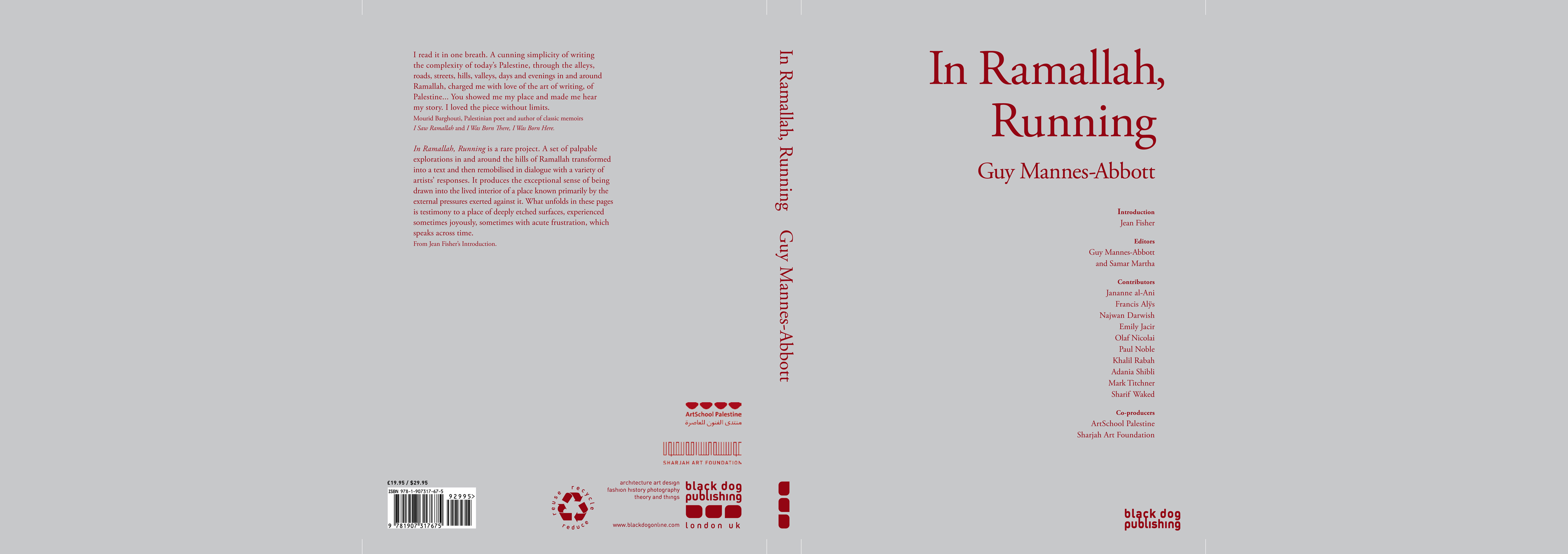
In Ramallah, Running cover artwork – click on image to expand

In Ramallah, Running

Guy Mannes-Abbott

Edited by Guy Mannes-Abbott and Samar Martha

Introduction by Jean Fisher

Contributions from Jananne al-Ani, Francis Alÿs, Najwan Darwish, Emily Jacir, Olaf Nicolai, Paul Noble, Khalil Rabah, Adania Shibli, Mark Titchner, Sharif Waked.

Co-produced by ArtSchool Palestine & Sharjah Art Foundation

Published by Black Dog

“I read it in one breath. A cunning simplicity of writing the complexity of today’s Palestine, through the alleys, roads, streets, hills, valleys, days and evenings in and around Ramallah, charged me with love of the art of writing, of Palestine… You showed me my place and made me hear my story. I loved the piece without limits.”

Mourid Barghouti, Palestinian Poet and author of classics memoirs; I Saw Ramallah & I Was Born There, I Was Born Here.

In Ramallah, Running represents Guy Mannes-Abbott’s uniquely personal encounter with Palestine, interweaving short, poetic texts with exploratory essays. International artists and prominent writers have been invited to respond both directly and indirectly to the texts with newly commissioned works.

The principal text is a series in 14 parts, alternating running within the limits of the city and walking out from it to, along, beyond and off limits, discovering how insidiously mobile those limits are under Occupation. With singular style and compelling force, Mannes-Abbott generates a very special intimacy with a rarely seen or experienced Palestine; the actual place itself, the people in their place.

Jean Fisher contributes a substantial introductory essay, while the poet and critic Najwan Darwish and novelist Adania Shibli have written further captivating responses. Visual contributions include a project linked to a pair of paintings by Francis Alÿs, drawings of stoney aridity with ambiguous structures by Paul Noble, and a searingly intimate journal-based piece by Emily Jacir. Jananne al-Ani, Khalil Rabah and Mark Titchner contribute varying photography-based projects focused on the place and its relationship to the body and word. Olaf Nicolai contributes an angular text-based project and Sharif Waked highlights the abysmal ambiguities of the political context.

In Ramallah, Running
Paperback
160 pages
32 colour plus b/w ills
26.0 x 19.0 cm
10.20 x 7.5 in
ISBN 978 1 907317 67 5

NB: Advance proofs of the book have arrived and are really quite beautiful Continue reading “on in ramallah, running – cover artwork, advance info., etc.”

on a frieze review of ‘the country of the blind…’ with CAMP at folkestone triennial 2011

frieze_cover-143-240x314

2011 Folkestone Triennial

VARIOUS VENUES, FOLKESTONE, UK

Scroll down for review…

[NB Collaborations are a particular, demanding and beautiful form of work which I seem to have developed a taste for, at least in a visual art context and since 1997!

2011 was a year of varying forms of artful collaboration, each very special but none quite so intimate as this one for me; how it came about, whom it involves and the result of our efforts. To avoid the obvious-but-hideous potential problems of collaboration, a certain more or less unspoken [else endlessly detailed!] but deeply-shared approach to all-things essential is elemental. Continue reading “on a frieze review of ‘the country of the blind…’ with CAMP at folkestone triennial 2011”

on the comma, between ramallah and running and everything else

In Ramallah, Running due Feb. 28th 2012

Gertrude Stein didn’t think much of commas, you remember? I think a lot of Gertrude’s work and Gertrude herself, as Fruit Store regulars will know, but disagree with her about the comma.

Commas break-up, complicate, deepen, add dimension to statements and any prose that takes ‘sense’ for granted. They elucidate, make-difficult, render actual complexity. The comma in In Ramallah, Running does these and many other things for me…

Above is a graphic rendering of a tiny part of the cover-image of the book [actual cover image coming soon], in which the sticking-out comma sticks out!

Commas are inconvenient, never quite fit, force you to notice that which you might not, condense and disrupt [presumed, heh Adania?] sense, etc. They are abyss and peak, add crucial [a]rhythms and make for the elliptical.

Writing without these things is almost literally nothing…