anne carson; cage a swallow can’t you but you can’t swallow a cage can you: a sonnet sequence for roni horn


R. Currie and Anne Carson photo T Oelfke

Cage a Swallow/Swallow a Cage was performed twice on November 6th at the Whitney, during their exhibition of Roni Horn AKA Roni Horn. It’s part of the work that AC did during her Residency at RH’s Library of Water in Stykkisholmur, Iceland.


I couldn’t make it, have been requesting a recording of it for some time and now it’s up on their site here (UPDATED 2Mar2018).

The page includes stills and a downloadable mp3 of about 25 mins, which may not be there forever…

Thanks, you Whitneys…

UPDATE 17.xi.2010

Transcription of the event follows; Continue reading “anne carson; cage a swallow can’t you but you can’t swallow a cage can you: a sonnet sequence for roni horn”

richard hamilton at the serpentine two; a tale of two palestines

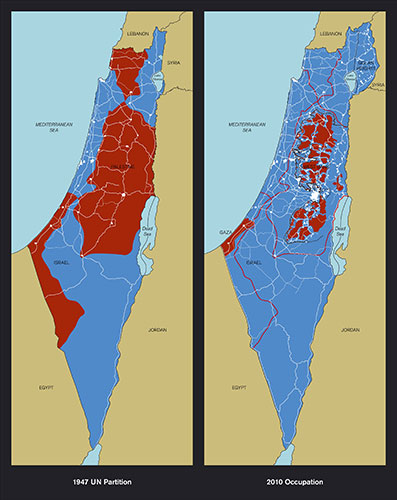
I want to write something simple, direct and therefore probably clumsy about what is going on when established art critics ignore and/or get snippy about a piece like Richard Hamilton‘s bold, brave and irreducible [this is the rub of course] work; Maps of Palestine.

Recognising the ethnic cleansing of Palestine and subsequent six decades of uniquely chronic entrenchment, overt war crimes slash crimes against humanity [oh those yada yada], ever more settlements and greater delusional sanctimony is forbidden in public discourse in Britain. Hence my ‘clumsiness’; you’ll need an open or well-informed mind to read on while I stumble through the ‘unsayable’.

It’s forbidden -or ‘unsayable’- partly because establishment Britain continues to offer cover as well as arms to the brave pre-pre-emptive killers of uniquely dispossessed, starved, besieged, picked off, randomly bombed, endlessly redisplaced and remassacred Palestinians, but also because it looked the other way for so long during a genocide much closer to home.

Maps of Palestine [2010] Richard Hamilton [w. thanks Eyal Weizman]

RH’s monumental maps are heart stopping; their allusions more shocking than anything that Koons and the Gang can muster. Art critical consensus mutters divertingly that it’s not really art is it? and if it is, it’s not really any good, is it? And, oh aren’t we a bit bored of this? They can’t say that about Unorthodox Rendition because it resonates visually with the equally ambiguous, uncannily similar, iconic image  of Jagger and Fraser, Swingeing London 67, which is secure in art history, but Maps is fair game, it’s easy…

Easy to ignore or disparage; bad politics and/or bad art. One of its actual characteristics is ‘simply’ political; the fact that it is a bald rendering of two maps of Palestine which make it evident that Palestinians have been cleansed from their homes and land and are now confined to tiny littering ‘camps’ [in Agamben’s sense, yes, but not exclusively here]. There is no disputing possible, no interpretation; this is simply the case. Which is why it’s not art, innit? That is; ideologically blinded by a perception that it’s ‘simply’ political, they can’t see anything else.

I want to say something about the way in which it is art in definitive ways and how its potent ambiguity as an object also makes it strikingly good, or anyway, lasting, art. It crystallises something unseen/unrecognised about the present which will resonate/fascinate in the future when ‘we’ will see better and with unerring perspective. In order to make that point carefully and probably clumsily I want to tell you another true story about Palestinian dispossession with covert establishment support.

The first time I actually met Mourid Barghouti, the great Palestinian poet and memoirist, was at a writer’s event in Norwich in 2005. These kinds of things; lots of writers from all over the place brought together for a ‘productive’ exchange, are often dire but this was not, I think. However, there was a round-table event that was profoundly degrading as well as terrifying in its way. A writer called AB Yehoshua was present, a man whose work is credibly literary, presumably the work of an agile albeit conservative mind. I don’t say this in the corruptingly ‘even-handed’ way that has so glossed Palestinian dispossession, but because I had positive expectations of him.

At one session, Mourid spoke very precisely about his own displacement and of place itself with a minimum of nomination, though of course when you tell the truth, even glancingly, it’s likely to hurt someone. He was calmly precise in mentioning some facts and asking open albeit suggestive questions. It was scrupulously exact and even respectfully polite; therefore very potent. For those who knew the background in depth it was clear that merely being allowed to stand there and say anything as a Palestinian was a mould-breaking, radical fact in itself.

[Actually, you can judge my memory  because Mourid’s paper Place as Time is online here and, in fact, pertains to what I’m trying to say here more broadly than I remembered]

When it came to Yehoshua, the tank-like figure that had barged and roared into the room morphed all-too easily into the Sharon-like Commander of US-supplied artillery. Spotting a Palestinian he opened fire with all he had to hand, no questions asked, perfect immunity assured and, however often this happens in actuality,  it was extremely shocking to witness. His blind rage, I mean in particular, and boy did he bluster and wow was it obvious that this is how it goes. He objected to something that all present knew to be the case; a recent example of Palestinian women being forced to give birth at illegal checkpoints erected on occupied territories held against International law [and more profound things] for decades.

The mere mention of this incontrovertible fact as an open question sent Yehoshua off into a reflex torrent of incoherent, self-defeating abuse in which he sought to say in essence; well if you weren’t intent on murdering lil’ ‘ol me I wouldn’t have to do it … if only you could grasp the relentless responsibility-taking that I do each and every day… but what would you know about that?

Somewhere in his rage he was complaining about the responsibility of the artist for what they say and/or do.  The obscenity of his violent outburst centred on his abuse of the most responsible of poets who had just given a very precise and elegant paper which exemplified the burden of artistic responsibility to perfection. Yehoshua meanwhile, abused his presence, his voices volume, the complicity of the British establishment, and raged on irresponsibly, not only refusing to take any responsibility for actual ongoing crimes, but abandoning any claim of artistic writerly responsibility in any and every conceivable way [and yes, I raise that to the highest, broadest of ethical categories].

His behaviour was obscene and cowardly; safe in the knowledge that he was squatting on a tank. It was terrifying because it revealed an entirely warped mindset, deeply entrenched in mass violence and practised impunity. At home his tank contains missiles. After missiles. After missiles. Here, his words were unleashed with the same intention; to kill the poet, the Palestinian, the other and any substantive sense of responsibility in art or elsewhere. What was shocking, indeed terrifying, was the knowledge that this small incident is played out endlessly, on a much greater scale, with blood and families and farmland and has been for more than six decades.

Almost more shocking was that the Chair made no sign of complaint, didn’t even notice anything unusual. It wasn’t that he felt awkward about how to rein in the verbal violence and lack of elemental human decency but that he was [I’m being kind] so immured to the established British discourse that he didn’t think there was anything even slightly odd about the outburst.

Art critics querying/ignoring Hamilton’s particular piece are not the Yehoshua in the story so much as the Chair; doing the work of casual complicity, blind to what is before them, ignorant of the artful potency of facts or the potency of facts used artfully.

The point about Hamilton’s piece of work is that it shows two separate realities -one potential and one actual- and makes no attempt to force meaning between them. No pointing, telling, explicating, merely the erection of two objects in space and time alongside each other; all relations open, a deep elliptical hole -more mysterious than a slathered over Anish Kapoor- of perfect ambiguity. As a work of art this is as close to the essence of what it is as you can get without it needing to be the most brilliant piece of art ever made or seen. To question this as art is to cancel art as a category.

Think of poetry and how it’s essence lies in Agamben’s reworked classicism; the enjambement of sound and meaning. Without the non identity of metre and sense text is not poetry at all; it only emerges as poetry in the very ellipsis formed [and is otherwise ‘mere’ prose] [See my Introduction to MB’s Midnight & Other Poems]. Similarly, it is the openness of the relationship between images [as well as viewer/s] here that makes it art.

One response to it is indeed simple, factual and unchallengeable; it is a map of ethnic cleansing yes, every bit as rigidly horrifying as aerial photographs of the infrastructure of death camps in the early mid-1940s [or that of settlements in the late 20th and early 21st century]. Infrastructure which, as here, war machines flew over without blinking, noticing, taking any responsibility for. ‘Camps’ which suit a purpose, a game ‘larger’ than the facts of chronic ethnic cleansing on the occupied ground.

A work of art, like a poem, that reminds me or exists only in this most elemental threshold zone is a blessing to receive. Before you tell me -or yourself- that this is not art or that it’s bad art, or that it’s ‘message’ is not very successfully conveyed, sit down and articulate to yourself what the relationship is between these two objects or images and then what the relationship is between them or that and you as a viewer. You might have to talk very precisely in general, and especially around how you distinguish the form that these two objects take from, say, two naked human figures stood in marble alongside each other. Why is that art? Why is that not bad art? Are you beginning to get it?

In fact this particular piece is not only a purified form of art, it is also fantastically humble and/or profoundly ethical art-making; an act undertaken for the other and otherness in its widest sense. I’m tempted to equate the refusing of it [the refusing to see or acknowledge it as art] with if not a crime but arguably an act against humanity.

I’m reminded of the sophistry that Emmanuel Levinas betrayed in an important and fascinating exchange in the immediate aftermath of the massacres at Sabra and Chatila, when a profound ethical response from a position of strength [the head of state responsible for those particular massacres said ‘No-one can teach us anything about morals’; an approach adhered to across the end of the century and beyond] might have helped [see; The Levinas Reader, ed. Sean Hand pp 289-297 Blackwell Oxford 1989]. If he misrepresented himself in the friendly context of the exchange, then it too was an ethical failure, surely?

Here is the contemporary face of ethical art making [with all its responsible innocence]. Today it is what it is, one day it will have extraordinary potency as a cultural object, a work of art. This image is only possible now; it is today writ large, in all its stark horror and misrecognition. Tomorrow it will seem inconceivable, impossible, absolutely mysterious. Tomorrow no-one will casually dismiss its status or its efficacy as art.

Tomorrow all those smugly complicit commentators will be eager defenders of the importance of memorialising the Nakba; the most committed to never again allowing humanity to descend to such depravity for so extended a period; the most insistent on the uniqueness of this horror, resistant of diluting comparisons to any other. But not until tomorrow.

Hamilton’s show contains a number of contemporary icons, stretching across the years and building potency in the present. With the new work, shockingly radical because so little else is, the show could almost just as well be called This is Tomorrow, but then that sounds strangely familiar…

aisha khalid & imran qureshi @ corvi-mora to 6th march only

Pattern to Follow 2009 [DETAIL] Aisha Khalid

There are two very good reasons for me to return to the work of these exceptionally good artists. Firstly, it is the last week of their exhibition at Corvi-Mora. Secondly, the publication of extremely beautiful artist’s books by Raking Leaves is imminent. Exhibition and publications are best seen together. To do so you’ll have to hurry to the gallery this week [11-6 Tuesday-Saturday], then hold out until the publication date of 30th March.

AK is showing four large new paintings which mark a stylistic development on previous work, showcased in a retrospective at the surprisingly capacious Pumphouse Gallery in 2008. IQ is showing six small paintings from his Moderate Enlightenment series; complex portraits of his wife, self, gallerist and studio assistant. In truth it’s a frustratingly small selection, given that both artists deserve the attention that a gallery like the Serpentine can give their work individually. I’m counting the days until it catches up, but quietly dreading some kind of ‘Pakistani Byway’ confection instead.

AK’s new works render beautiful abysses into which swirl complexly patterned stars and squares of gold leaf. There is an all-consuming joy and abysmal dread in them, they are cosmological and catastrophic, thresholds and black holes. Her work has previously excelled with ambiguities of perceptual, personal and architectural space, explored realms of looking and being seen -with all the import both contain in our world of phenomenal/ogical ignorance- and return again and again to the [illustrated] book, often literally with exquisitely rendered lined pages from school books.

Along with a kind of undeclared Islamic minimalism in the work is a politics that has grown ever sharper. From problematising notions of the gaze, in which veiled women become what you want to see, her work has reached a stage where the pretty decorative ‘holes’ created in and by patterned, pulled together edges of fabrics, resemble bloody wounds in bodies with all-too real War on Terror referents. See the work made for the Queen’s Palace in the Bagh-e Babur, Kabul last year here and here.

These newest works are called Pattern to Follow and embody a distinct break. It is as if she can’t bear to look any more, has turned her eyes pleadingly towards an infinite universe or the embrace of god, her hands to the making of open questions. What has previously been indirect has turned full circle so that her most abstract even decorative works, I can’t help feeling, are most revealing of their actual context [WoT’s totalised global violence]. Elegant, visually compelling, geometrically abstract, non-declamatory, yet invested with passionate appeals to some form of justice beyond reach.

The Artist’s Wife & The Gallerist 2009 [DETAIL] Imran Qureshi

IQ’s works are from the ongoing series Moderate Enlightenment. Here he locates western representational portraits within familiarly patterned floral landscapes or more abstract spaces. Some of these highly refined images are then framed within a series of lined boxes which reframe and link with abstract shapes floating like blind spots from the sun to left or right.

These six make an unlikely introduction to his work and are not the strongest argument for its profound innovations. However, they are fascinating to linger with and contain many of the visual and other elements that characterise his wider work. There are hip young things standing in classical landscapes; one male figure stands at an uncomfortable angle to the viewer, casting an unusual shadow on the foreshortened wall behind him.

IQ’s self portrait is a head in profile within a tilting oval, surrounded by a wide mount of gold leaf. The head is naturalistic but doesn’t actually resemble the better looking artist. Every hair on his head seems to have been rendered with the miniaturists famously fine brushes and the flies swarming before him evoke the heated atmosphere in which the work was made. IQ’s trademark leaf-bouquets [reappropriated from Kangra paintings and made to symbolise love] loom beside his wife and gallerist -the latter’s woollen jumper displaying furry licks.

These paintings of IQ’s contain love ‘poems’, perhaps ghazals but in any case they represent a relatively benign world compared to his wife AK’s evident [though still always open, ambiguous, ambivalent] concern or anyway, the seriousness of her new work. There is a curious dialogue going on here and I like the workshop feel of them showing together, something explored to its limits with an earlier project called Kharkhana [a very fine catalogue is available here]. However, there’s no sense in which either ‘needs’ the other and as an exhibition it would compliment the work of both to show more work separately.

nasreen mohamedi; to basel 7 feb – 5 april

Nasreen’s Notes – Reflections on Indian Modernism [Pt 1] has now settled at the Kunsthalle Basel until the 5th of April.

More on the show is here. More on Nasreen Mohamedi is in an earlier post here and the current issue of Bidoun. Catch her work live if you possibly can.

The Estate of Nasreen Mohamedi is represented by Talwar Gallery NY here.

Where next? What next!

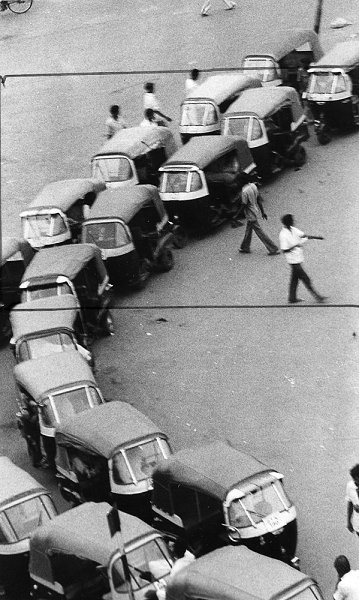
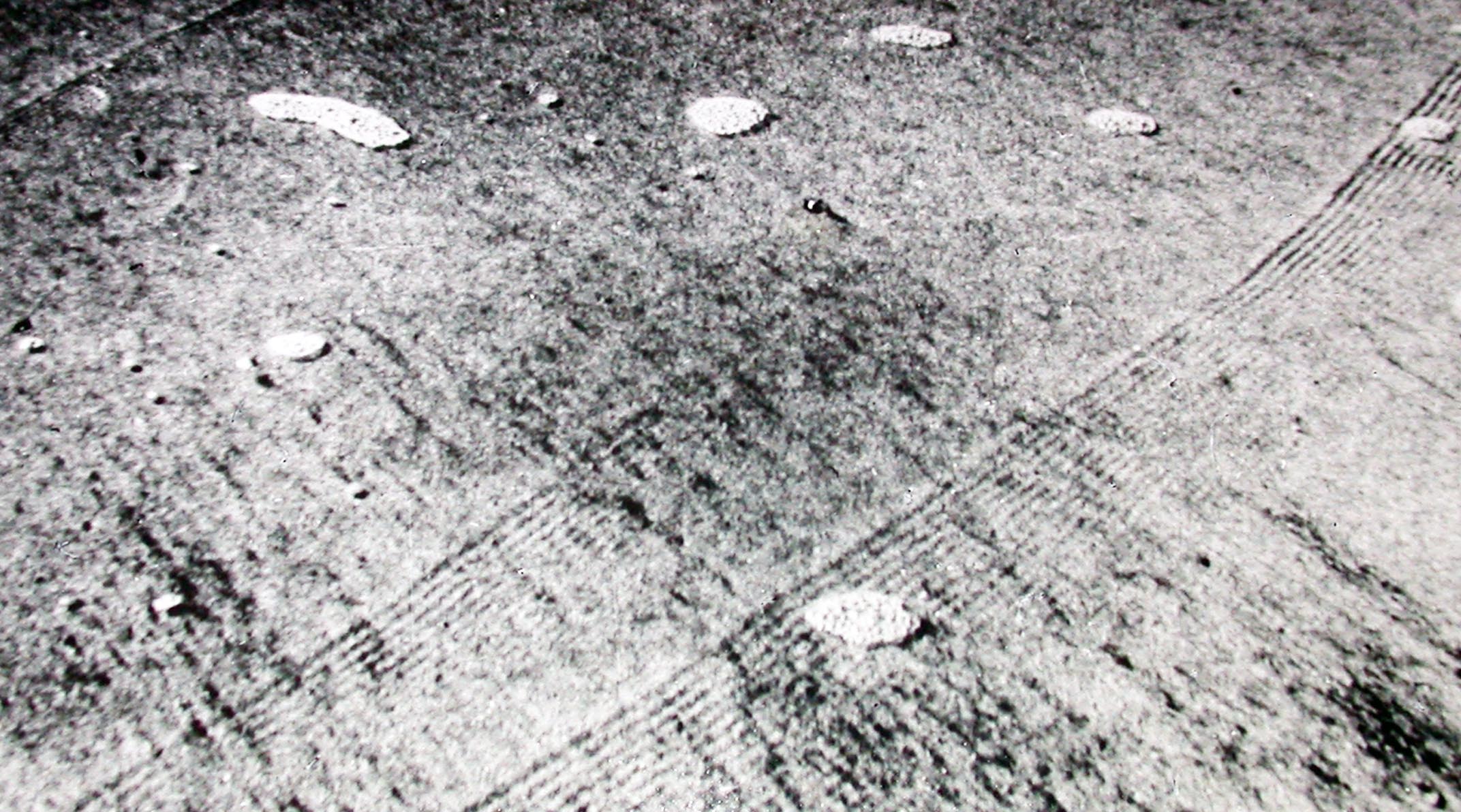
This image is one of several in the show, in which she has reframed high contrast photographs of the street, backyard and classroom furniture at Baroda where she taught. No direct link to her drawing, plenty of indirection…

subcon survey two/ whitechapel’s where three dreams cross & dayanita singh

The Whitechapel Gallery’s Where Three Dreams Cross [more info/artist list here] is another attempt to make up for long neglect. It’s sweepingly broad, with photographs from India, Pakistan and Bangladesh ranging across 150 years and grouped thematically; Family, Portrait, Body Politic, etc. These bundle together anonymous studio portraits, family snaps, publicity cards and photojournalism; images historic and incidental, urban and rural, plus work from artists born in 1870 through to the 1970s -including Bani Abidi for example.

I have as many curatorial queries if not criticisms as there are images and they thematise around the question of who this is aimed at? But Where Three Dreams Cross is essential viewing. It’s a pay show, but admission is free for under 18s and all on Sunday mornings from 11-1 a.m. You’ll need hours or more than one visit and can’t rely on the catalogue which has useful texts but is a frustratingly incomplete record.

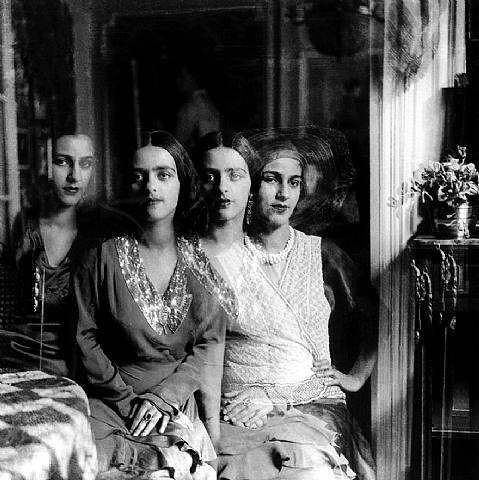
Quartet & Doppleganger [Two Amritas] fromRe-Take of Amrita 2001 Vivan Sundaram

Amongst the multitudes are famous people and princes, rare images of poets and musicians, familiar ones by the A.S.I., Lala Deen Dayal, Raghubir Singh and Ragu Rai, for example. What makes it work are the glimpsed treasures; a set of hand-tinted [or miniaturised, popular-style, peacocks and all] family portraits staged before temples, another of Sufi Pir Baba by Tapu Zaveri, selections from Jyoti Bhatt, Gauri Gill [see Bidoun’s Noise] and Aasim Akhtar, as well as the brilliant Unknown and Anonymous.

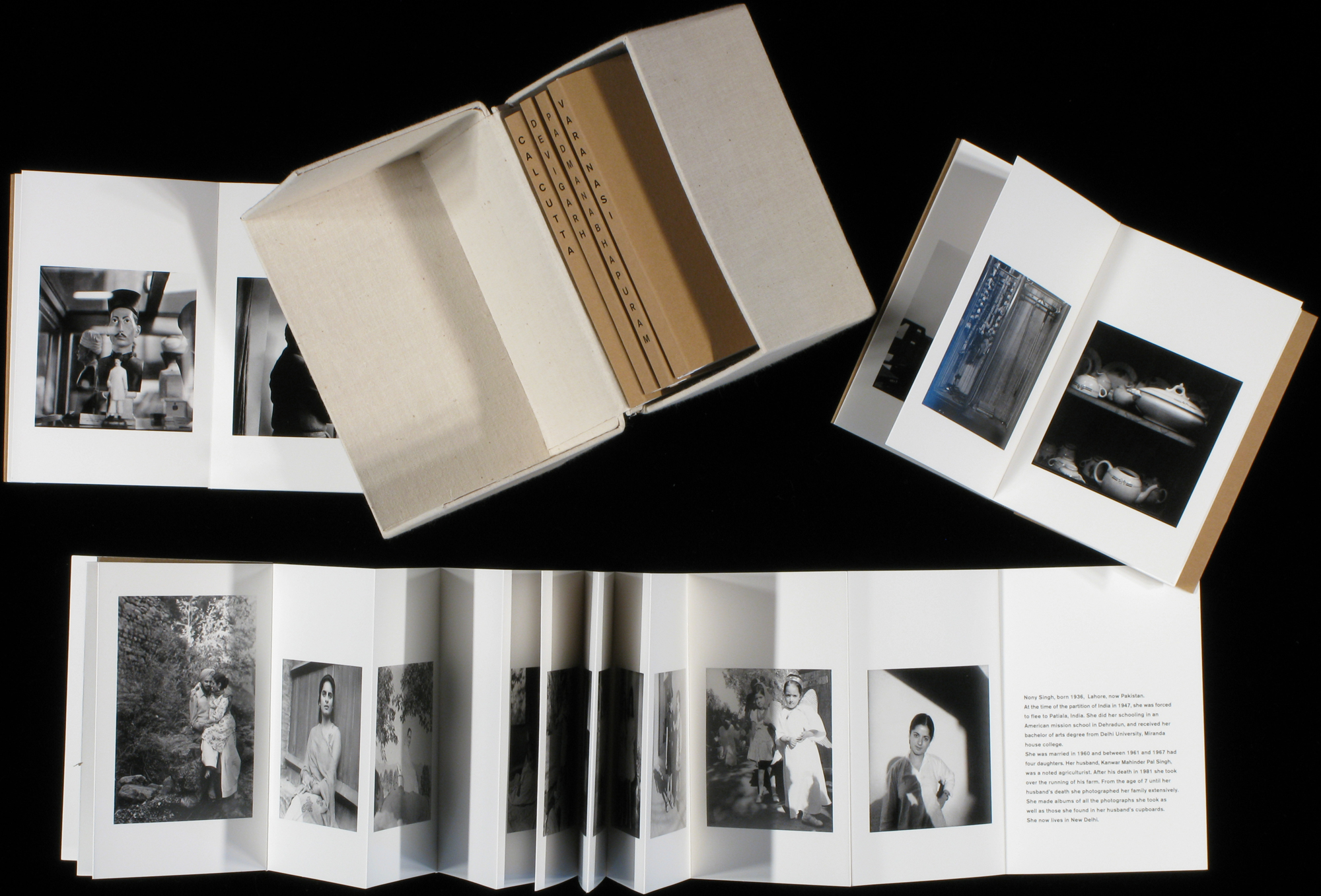
Then there are the peculiarly subcontinental linkages/lineages; Umrao Singh Sher-Gil’s mesmerising self-portraits downstairs, as well as Vivan Sundaram‘s photo-montages of Umrao and his daughter Amrita Sher-Gil [aunt of VS, who is married to art critic Geeta Kapur who supplies a catalogue essay] upstairs. Then there are Nony Singh’s photographs of her family, including ‘Nixi’s’ young life up until she leaves for college in Ahmedabad, Gujarat…

Dayanita Singh: Nixi on Foot at the Dream Villa

Dream Villa 16 2007-08 Dayanita Singh

‘Nixi’ is Dayanita Singh, represented here by recent Dream Villa photographs in colour and her project of 7 fold-out booklets, Sent a Letter, which include Nony’s photographs with her own of Allahabad, Calcutta, Varanasi, etc. I’m torn between choosing one of DS’s poems -as she calls them- from Dream Villa and one of her mother’s family snaps.

Nony took photographs of her family obsessively, some of the evidence is on the wall, more of it is on Nixi’s face here. In the exhibition this image comes with vital additional notes; “Nixi on her way to study at the National Institute of Design. I just knew she was talented as an artist and fought with my protective husband to let her go. It was expensive. I had no idea what she would become one day”.

I was admiring too but a bit sceptical of what DS did in her early [intimate, ambivalent] tableaux of variously located privilege and desolate or evacuated grandeur. However, in parallel with her brilliant Myself Mona Ahmed [Scalo 2001] project -published with emails from subject to publisher- they promised much and have arrived at something very special. A few pages of MMA and Privacy [Steidl 2004] occupy a vitrine here.

Dream Villa‘s images of nocturnal street lights exemplify this specialness for me [see current Delhi show]; the familiarly angled, bolted-onto-anything lights of urban back streets and the edges of connected-up villages. I loved them when she showed them first in London [2008], recognising their airs -the times and spaces they illuminate- but wondered momentarily if that recognition was necessary for them to ‘work’. In fact, Dream Villa represents a clarified art that needs no referent -even if they can be found. It is what it is.

Nony’s image of Nixi about to set foot free is quietly exquisite. It reminds me of a letter of Emily Dickinson’s which asks; “How is your little Byron? Hope he gains his foot without losing his genius. Have heard it ably argued that the poet’s genius lay in his foot -as the bee’s prong and song are concomitant.” Nony’s image is of her own Byron gaining her foot, impatiently patient in shades of possessive release.

Where Three Dreams Cross is full of little moments of this kind. Little moments of layered resonance. Here Nixi in the eyes of Nony echoes the work of Vivan with his aunt and grandfather -minus self-consciousness and compelling perversity. Moments that insist upon further exploratory exhibitions of  depth, substance, context and celebration beyond this prefatory survey.

subcon survey one/ saatchi’s the empire strikes back & yamini nayar

I don’t like survey shows -especially of the squeeze a culture or a continent into one building in London type- but The Empire Strikes Back at the Saatchi Gallery is a must-see. It’s an elegantly curated glimpse of subcontinental art weighted, of course, towards Big Statement and Painting -most of the latter of which could date from any of the last five decades.

Of the bigger names here -Subodh Gupta, Bharti Kher, Jitish Kallat, Rashid Rana- I’m happiest to see Atul Dodiya’s scandalously neglected work in London and now hope for a dedicated exhibition of it. The ‘blame’ for such seasoned indifference and the real limitations on this particular show are contextual; British incuriosity about the actuality of India [and beyond] despite its renewed global status.

Admission to Saatchi’s ’empire’ is free; no complaints, no excuses!

Yamini Nayar: What is Essential

I’d not come across Yamini Nayar or her work before. Born in Detroit, resident in New York, claimed by art criticism as one of the upcoming stars of new Indian art, her work  explores ambiguities of exactly this kind. Saatchi is showing 4 photographs dating from 2006-08; table-top constructions of mostly interior spaces, assembled from scraps/found objects before being photographed and discarded. Her own website [which includes her Studies; potential buildings rendered in lines drawn on photos of derelict sites] is here, and her gallery is here.

What is Essential 2006 51 x 61 cm Yamini Nayar

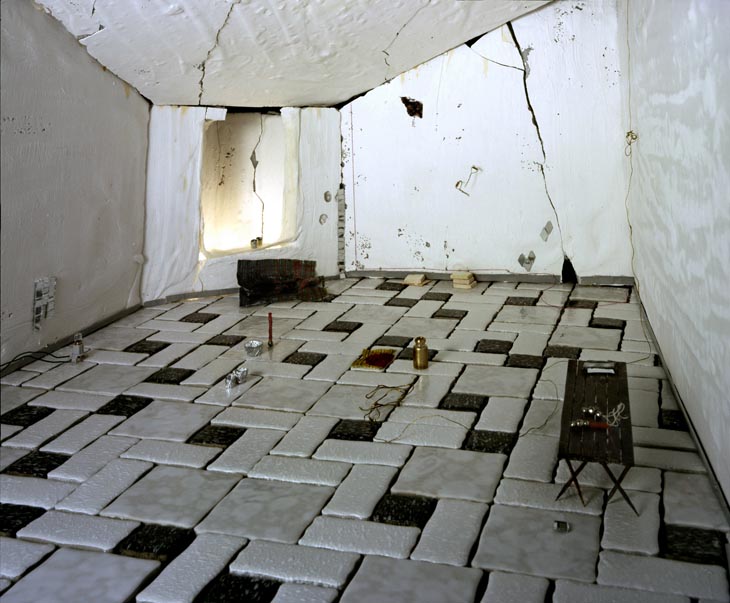
One way of entering this image is through David Lynch and the uncanny, but why use the back door? These highly ambiguous spaces are more potent with now: the world as it is and might be. What is Essential is surprisingly but appropriately small in actuality. It’s also one of the most close-up and two-dimensional of her constructions and thereby unrepresentative, but it contains all that intrigues me in her work.

At first glance What is Essential is a room, oddly but recognisably decorated. It could be anywhere but then again it must have been approached via the subcontinent; the simultaneity of four textures, the unlikeliness of those bird sculptures, the glittering objects on floor, table and wall. At the same time it’s an image about the u-topic quality of space in 2010; everywhere and nowhere, spontaneously generated as place, a kind of archival utopian vision.

But it is the coppery ‘gold’ button with its ambitious thread that engages me, granting the possibility that the parachutist might be on his way up rather than falling, captured in flight like the birds. This element is more typical of her other work too; the use of objects with ambiguous scale, or of objects as synonym or metaphor, stand ins for other things which are also approximate. The catalogue describes these objects as ready mades, which is reasonable, but then their readymadeness requires specific referents or context. What is their context?

In this model of a suggestively real interior, the button -if that’s what it ‘is’- is an open signifier. Nayar’s art is located here; the other photographs in the show and beyond build from this and this is why they are so potently suggestive. Suggestive of architectural, cinematic, religious, domestic, crime scene, student bedroom, sufi retreat, miniature painting, spooky/site-specific art installation as well as many equally improvised rooms that I’ve stood in in big cities, mountainsides or on desert fringes in the subcontinent itself.

I want to insist that these are not stills or single frames but movies, dense poems, potent visions, proper ‘utopias’ for our age; broken down but also cobbled together, existing, even if only in this moment now. The task is to extend the moment and build in it…

10.09. from gupta & harsha to london, now that’s what i call music

During the last year London finally began to notice the breadth and depth of subcontinental visual art. A form of catching up across loosely defined generations has been going on, symbolised in October 09 by Nasreen Mohamedi‘s ongoing retrospective at MKG, Subodh Gupta getting a showcase at Hauser & Wirth, NS Harsha with an installation at inIVA and a solo show at Victoria Miro, as well as another intriguing group show at Green Cardamom. As crude a notion as ‘catching up’ in this way is, it seems that London’s tokenistic effort to do this with the Serpentine Gallery’s Indian Highway in December 08 just might also be the last of its kind.

Veil [detail] 2005 Aisha Khalid

In contrast to the Now That’s What I Call Music approach of group surveys, Tommaso Corvi-Mora has shown Aisha Khalid and Imran Qureshi, two of the best artists from an established generation in Lahore, Pakistan, since 2001. A similarly smart curator could yet put together a show of Bhupen Khakhar’s pop art from the 1970s for example. Another could put together a retrospective of the influential late Lahori Ustad Zahoor ul Akhlaq. Perhaps ‘West End’ gallerists ought to be showcasing artists from the next wave, like Naeem Mohaiemen, Khadim Ali, or Mohammed Ali Talpur for example. That is; as well as rewinding and catching-up why not just press play?

I don’t mean to exaggerate London’s importance -it probably needs the subcontinent more than the subcontinent needs it- but it reveals an approach predicated on the take-out or the M&S spicey snack; diluted convenience over actual cuisine or anything else. The same is true in the world of books, where the UK prizes writing prepared in English at the same time as translating very nearly nothing.

Gupta and Harsha are Indian artists with global reputations, about whom London had very little to say, at least critically. I came across the former in Delhi in 2002 and had too much to say about the recent work to post my notes here, but in summary:

Subodh Gupta Common Man Hauser & Wirth 1-31 October 09

The proportions of Gupta’s first major exhibition in London were peculiar. Its occasion was part introduction, part retrospective, its character declarative and incantatory. It spilled across two sites in Mayfair, imploding with a self-consciously wide range of forms, tongues and bases with pointless talismans [Wall] and point-scoring appropriations [Et Tu, Duchamp?]. The solid core were subtle variations on now familiar stainless steel sculptures [Everyday, I Believe You, A Penny for Belief II] here on marble plinths; offerings and monuments both quotidian and sincere. The most interesting work [Spooning, Black and White] showed a further refining and abstracting of his own sculptural language  which augurs well. Gupta is an artist unafraid of thinking big in the best sense, making art that is powerfully symbolic of everyday life experience. Art from nothing and everything, for the ‘common man’ of lore and life itself.

Here are my abridged notes on Harsha’s show at Victoria Miro 10th October-14th November 09.

NS Harsha Picking Through the Rubble

by Guy Mannes-Abbott

NS Harsha has been here on his way around the world before now but this exhibition at Victoria Miro is his formal introduction in the UK. Harsha is primarily an artist of paint. A painter who uses various vernacular mediums of Indian life and art to adorn almost anything, anywhere. His works have been miniatures ‘quoting’ from Company paintings to comment on colonial legacies with great wit. They’ve been murals painted on to walls, deriving from the village arts and crafts found across India, and bringing the everyday to life in site specific works across the world. Victoria Miro is showing large mural-inspired paintings of his delicate kind which are, incidentally, his most saleable work yet.

The ground floor gallery shows off a set of five large canvases with thinly applied acrylic in soft hues. All are 5 feet high and 12 feet long; the Imperial measurements somehow appropriate and one of few unselfconscious markers present. Harsha has lifted his art off the walls to join in on an art market that requires it to hang independently. As his international reputation has grown, his site specific works have magnified too. The upstairs gallery here contains one such pointlessly scaled installation; a made-for-Museum piece called Either Side of the Path of Enlightenment. Hidden away nearby is Eclips; a modestly sized canvas of Harsha at his best; elliptical, mysterious, warmly human, wittily questioning.

Harsha’s large scale murals share qualities of pattern and looseness from the wall-mural tradition, overlaid with his trademark specificity of person, face, moment. Spot an innocent civilian and Thought pickers especially, but also In musth, could pass as wall paper with their repeated motifs. Harsha wants us to look more closely at things we think we know or recognise. At his best this process is a witty but also sharp political commentary, veering on the philosophical. This is the quality that distinguishes Thought pickers, an Untitled canvas as well as Eclips but it’s precisely this that amplification for the market’s sake threatens.

Harsha’s ‘innocent civilians’ are rendered with a halo like effect around individuated heads. To the right of the canvas and in its midst is an exploding suicide bomber taking out those nearest her in an acrobatic display of painterly gesture. Her halo is less crisply rendered but I think it’s still there; Harsha is no reducer of sense. A decade ago he painted a series of miniature sized pictures which played with the same ambiguities of language to similar effect. One of those, Native Intrigue, also took a phrase from the dominant ideological lexicon and inverted it to reveal and softly ridicule its limits.

In the War On Terror we’re all innocent civilians as well as all-knowing and complicit. Harsha is reminding us that if we perceived ourselves as global citizens, we could no longer stand by while crimes against humanity, war crimes, murderous sieges and mass murder in the guise of democracy are perpetrated in the ‘defence’ of our ‘values’. So we’re the opposite of innocent. Perhaps the least invested in our shared guilt is the suicide bomber in this mural who is at least protesting. Whose guilt is confined to small-scale, handmade outrages.

Untitled 2009 [detail] N.S. Harsha

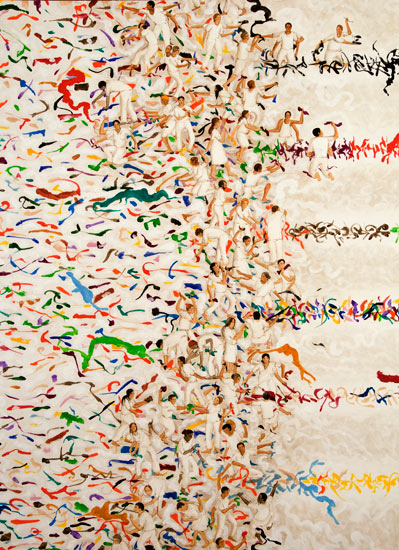
Untitled is Harsha at his best; a broad philosophical insistence rendered as gently as possible and more characteristic of his body of work. This huge mural on canvas divides in half; on the left are a mass of painterly gestures, scraps of colourful fabric, unordered or unformed, individual, intensely vibrant. On the right they’ve been woven together into something strong, useful, evidence of human presence. Rendered at many angles in the muddied middle are busy human beings turning the scraps into thread. Collecting, gathering, weaving, moulding, working up the disparate into something with collective strength. Something formed. This is enough; there’s no manifesto delimiting what that collectivity, strength, humanity or purpose ought to be but no baulking at the absolute necessity for it.

A couple of canvases –In musth and Absurd blossoms– feel forced to me in exactly the way that Harsha’s best work is not. Thought pickers makes the point; being typical of this set of new works but as natural and easy as the witty precision of layered intent it contains. Again we have repeated motifs; individual bent backed figures regularly placed on the canvas. Each has a collection of brightly coloured rags, paint strokes, petals on their backs. The colours are the thoughts, the figures are pickers, collectors, bringers-in of the thoughts used to sustain life.

Harsha’s figures are modelled on urban rag pickers and rural twig and stick pickers; gracers of subcontinental back streets and rural tracks, gatherers of subsistence. This should give us thought, not least about the way this apparently impoverished existence is also sustainable. Thought pickers renders a kind of inhuman abjection and yet it comments on our thoughtless acquisitive purgatory in ways that are unique in their lightness of touch and softness of voice.

Upstairs, Eclips is more of this; a beautiful puzzle of an image, easily missed in the corner and set apart from the rather cumbersome ‘Path’ installation. Eclips is a divine droplet of Indian thought, containing a press of distinct human beings, falling through time and space, going nowhere, but underpinned with a mystifying carrot. Mysterious but not pointless; the carrot here might as well stand for the rewards of focusing on our shared humanity; those vulnerably massed group of people who share a single fate as they come in to splash down and begin life on earth. It’s a carrot in a world of sticks.

Harsha is an interesting artist who works political wit and philosophical incisiveness into a highly refined practice that is also essentially vernacular. As his reputation has grown, as London has finally realised the health and vigorous breadths of subcontinental art, his work has expanded in scale to meet the curatorial market. Thus size becomes a key demand, alongside concern about portentousness.

Harsha’s best work is the obverse of this; an irritant of the portentous, able to stimulate large and productive thoughts in us with the slightest of means and on the smallest of scales. These modesties are bound up tightly with the source, inspirations and languages of his art practice. The global artworld -certainly as manifest in London- struggles to understand or even recognise the modest scale of these subtleties and so forces even an artist of the wit and precision of NS Harsha into its mould.

Picking through the rubble here, there’s enough left to remind us of the real value in Harsha’s work. It’s also a happy day when someone of his particular set of skills breaks through to International recognition. The moment must be celebrated even if attended with sadness and regret when it reduces the singularity of the work in question. Hasten along to Victoria Miro and catch NS Harsha while he is still making his own work and while that work is still Harsha’s to make.

09.09. from baroda to bahrain and milton keynes; nasreen mohamedi

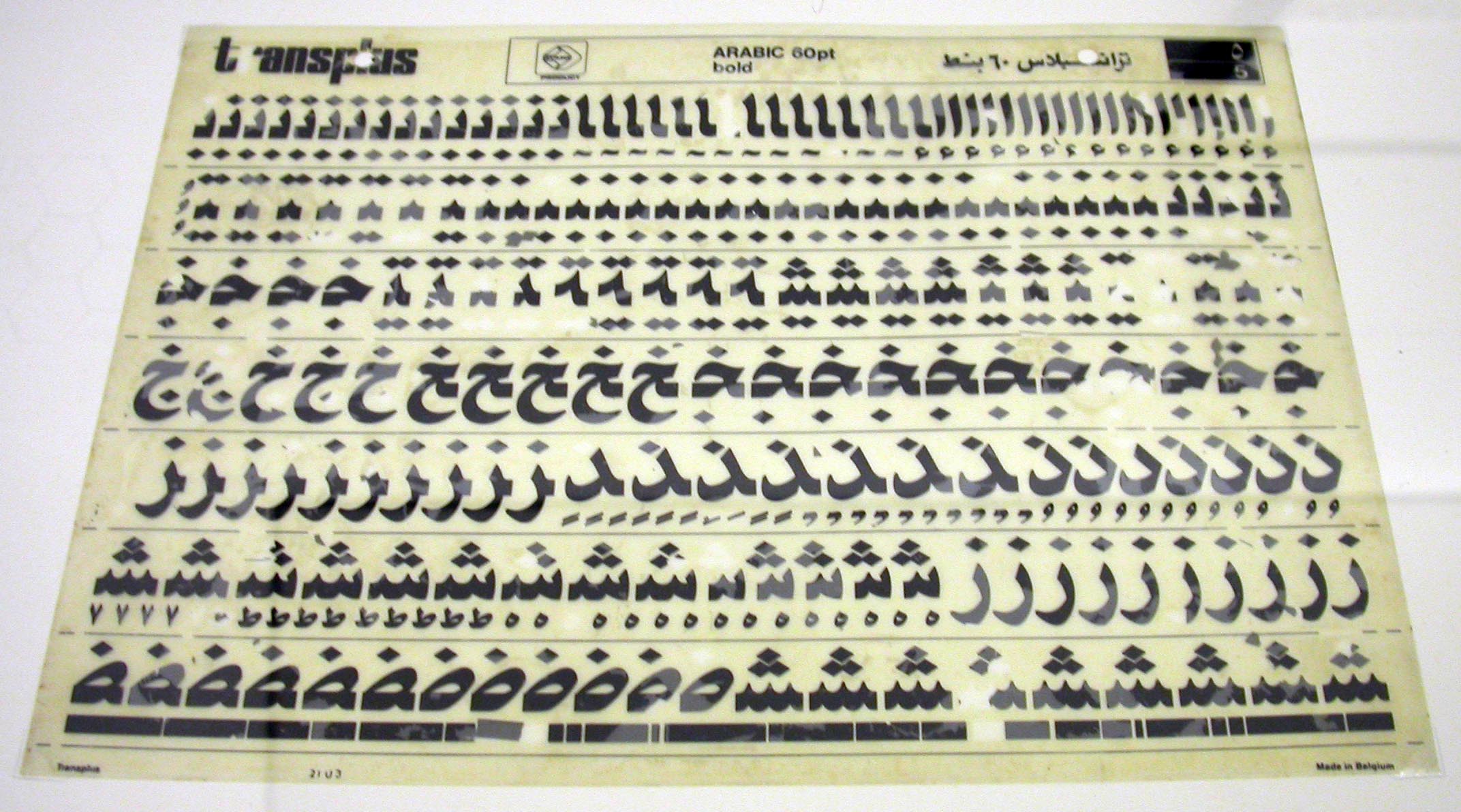
Arabic Letraset lettering from Nasreen’s studio memorabilia Ph Guy Mannes-Abbott

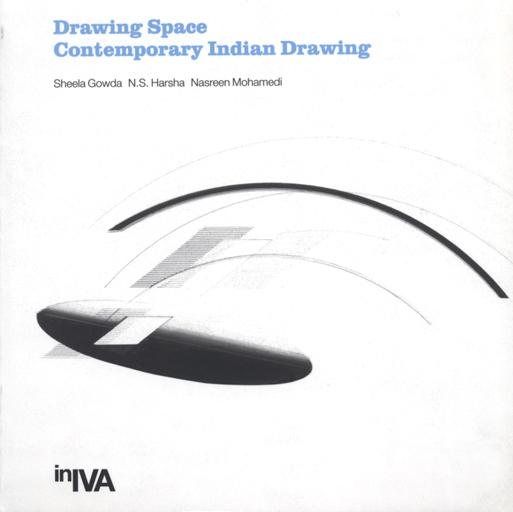
In September the fullest retrospective (Jan19link) so far of the work of the late Nasreen Mohamedi arrived at Milton Keynes Gallery. Nine years earlier, the curators of this travelling show, Grant Watson and Suman Gopinath, had asked me to write a catalogue essay for their ‘Drawing Space Contemporary Indian Drawing(Jan19link)  in London -which also featured Sheela Gowda and NS Harsha.

In 2000 NM’s work was almost unknown outside India and closely treasured within. It mesmerised me and became another of the endless roads that drew me to Gujarat. There I met her friends, as well as colleagues from Baroda’s Fine Art School where she taught for many years, most memorably the brilliant and beautiful Bhupen Khakhar who died in 2003. Before his death our friendship was sealed by witnessing the state-sponsored pogroms of 2002 [in which Muslims were burnt out and slaughtered across the state of Gujarat] trapped together in his car between burning road blocks and the main road where armed police gave cover to a well-organised ‘mob’.

Extreme close-up NM artwork: grid-ungrid-diagonal-to-curve Ph Guy Mannes-Abbott

MKG drew together two sets of drawings [from her family and the Glenbarra Museum, Japan], the broadest range of photographs yet shown, some diary pages, early collages and several vitrines of memorabilia and working materials. One of these contained photographs of her with family and friends, some of which were taken at Bhupen’s studio-home. One shows her with another artist-friend, Krishen Khanna, long the owner of my great grandfather’s colonial bungala in Simla, where his studio is ‘cut’ in to the mountainside.

NM’s reputation has continued to grow since 2000, especially after she was ‘discovered’ at Documenta 12 in 2007! I expected MKG’s comprehensive exhibition to trigger proper recognition as well as consolidate her art historical place. While the latter is an ongoing process, it was disappointing to see that she remains just a little bit too much to take on board for incurious British minds yet.

Close-up NM photograph of sea water, foam and lines in the sand Ph Guy Mannes-Abbott

However I was happy to be asked by Bidoun to review the exhibition and although it’s only a short piece, no less delighted to see it in the current issue Noise [Winter 09/10] which you can rush out and buy! I’ll post it here eventually but meanwhile here are some other links;

The Drawing Space catalogue remains the best introduction to NM, reproduces some drawings, extracts from her uniquely worked diaries -including a reproduction- and a photograph of her minimal studio. Copies of the elegant little book [which is as good on Gowda and Harsha] are still available for £7 at inIVA here, or Cornerhouse here.

Norway’s OCA originated a smaller version of ‘NM: Notes – Reflections on Indian Modernism [Pt 1]’. Their site has a page linking to a pdf [8.51mb] of a booklet with some reproductions and a text by Grant Watson. A version of Grant’s text is also in Afterall magazine’s Summer 09 Issue, No. 21 here. That issue of Afterall contains the best reproductions of NM’s notoriously difficult to reproduce work currently available.

In NY The Drawing Center produced a good publication for their ‘Lines among lines‘ show in 2005, including Geeta Kapur’s revised essay on her friend, which I once thought eulogistic but now find increasingly resonant. Talwar Gallery in NY has an artist’s page of drawings and the photographic ‘sketches’ which she never intended to show but which are fascinating.

Until a properly thorough monograph exists with suitably high quality reproductions of the work, the best source remains Nasreen in Retrospect Ashraf Mohamedi Trust Bombay 1995.