notes from a biennial – on reflection

click IMAGE to link to notes from a biennial – on reflection

Notes from a Biennial – On Reflection

21.03.2011, 12:01

by Guy Mannes-Abbott

The opening week of this year’s Biennial was very intense; promising and delivering much. I’m glad I had early access to it all, could play that off repeated circuits and discrete returns, along with mini wanders with various artists and writers, old and new friends, listen to other’s highlights, tips, and ‘zoom’ in and out of the city, region and world in the process.

I was invited as a writer to write critically and I would fail the Biennial as much as myself if I did otherwise. I’m a demanding judge or at least have very high thresholds and am not biddable! Yet Sharjah Biennial 10 has been a triumph for all those involved. It took big risks Continue reading “notes from a biennial – on reflection”

notes from a biennial – on a day of words [one]

Screenshot 2017-05-15 12.38.25

Screenshot 2017-05-15 12.38.52

(Links to the original SAF site and these thumbnails no longer exist. UPDATED 2017)

Notes from a Biennial – On a Day of Words [One]

Sharjah Biennial 10

18.03.2011, 14:06

by Guy Mannes-Abbott

It should not be a surprise to find a lot of words -in the form of writing and image- at this Biennial in particular. Then again, it is quite surprising to find quite so many high quality publications; from the hulking sanctuary of the ‘Plot for a Biennial’ catalogue [ed. Ghalya Saadawi], to the thumb prints of individual artist publications and on to the stack of books entitled Manual for Treason.

Words flourish here as text and speech as well as in many languages, signing the Biennial site and as translations of the variously published texts. ‘Manual for Treason’ itself [Ed. Murtaza Vali] for example contains English, Hindi, Urdu, Bengali and Kannada -at least. Manual for Conspiracy [Ed. Basak Ertur] is published in English and Turkish -and so on.

Throughout the Biennial works engage the world they were made to ‘breathe together’ with [to quote Ertur’s etymological elaboration on the word Conspiracy], to notable effect. It is to the credit of all involved that what these things mean has been taken seriously especially as it takes place at a time of real and systemic change in the region. In many places there is a radical revisiting of archives of revolution, from the large scale and actual [Harun Farocki & Andrei Ujlica Videograms of a Revolution 1993] through comic projection [Ahmad Ghossein My Father is Still a Communist 2011].

One morning artists and I breakfast on a headline reporting that Saudi Arabia and the UAE have sent military and police reinforcements to support the ruler of Bahrain. It’s clear that something must be said; next morning artists make a gesture of saying it. [For something of an elaboration on the wider context of this, see Notes from a Biennial – On Reflection] In the early hours of the next day, avid attention is paid to Blackberries for a New York Times report about a large group of distinguished artist friends, many of whom are present here, who have been working with Human Rights Watch to ensure or enable the coming Guggenheim Museum in Abu Dhabi to pay all those who will build and service it properly. (A small cut of this last sentence, made live -by me, for an unnerved curator friend then involved both with SB and GAD- March 2011 is now restored. NYT link here PDF below. UPDATED 2017)

Words. CAMP are showing their 65 minute film; The Neighbour Before The House [2009]. I’ve seen a version of this before -in a show curated by Samar Martha at the Liverpool Biennial- and settle to watch it all here. It is a fascinatingly subversive use made of surveillance cameras to explore the view of the Occupied in Jerusalem/al Quds. As the security cameras are turned against the Occupation, zooming in and out on details in otherwise prohibited places, voices describe what I’m watching in Arabic, their words flashing up in English below.

In one section a family whose home has been stolen and who are forbidden to go close to it, narrate what is being shown close up from a significance distance away; “61 days they haven’t once cleaned the stairs” to the street. One notable thing is that the building has been extended, a right denied Palestinians in Jerusalem and elsewhere. All of a sudden the family’s children appear before the house, insistently ignoring the ban and pointedly refusing to leave. Then there’s another child’s gasp as the mother of the family appears in frame, pressed up against security infrastructure attempting to peer inside her own, confiscated home.

Another section focuses on security cameras mounted on a building, but also a series of signature holes in the wall where they’ve been removed, on one occasion by a Palestinian seeking reparation -an anecdote that provides a bitterly comical moment. The words tell a familiar story to anyone who has noticed the daily demolitions, expulsions, detentions and killings that define the Occupation. But they remain peculiarly raw when, as Amitava Kumar’s contribution to the ‘Manual’ observes, “the world watches cowardly and indifferent.” [See Appendix i – Camp & I for an interview and more details.]

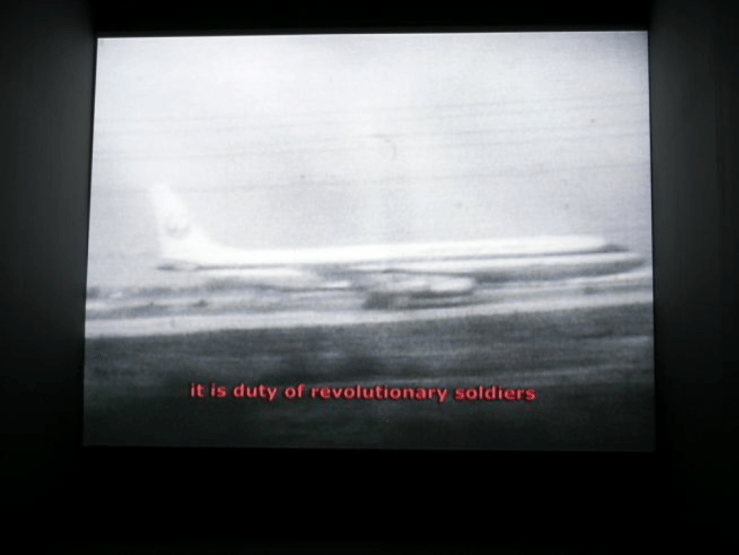
Words as aural and visual elemental are central to Naeem Mohaiemen’s brilliant and widely admired 70 minute film piece; The Young Man Was… [Part 1: United Red Army] which is about the hijacking of a plane to Dhaka by the Japanese Red Army in 1977. Tense negotiations ended with the release of hostages and the escape of the hijackers and prisoners they’d sought to free -during which time a military coup takes place. The end of the film lists the fates of many of the ‘cast’ and it’s notable that a number of Interpol warrants remain open for some of the revolutionaries involved.

NM found and used the actual records of negotiations between the control tower and the plane and those cryptic and repeated words make up a significant amount of what I’m watching, the sound track clear despite faltering English and Bengali background chatter. Viewers hear both sides from the control tower, which reveals the panic, duplicity and episodic fury that is anticipatable but unnerving to actually witness. It also reveals the robotic iterations of the hijacker’s simple and unswerving demands.

It’s a poem of a piece, beautiful executed, difficult to describe, not least because, as Naeem says himself, to do so and to sketch the mountain of which the film is a very small ‘tip’, takes longer than the film and inevitably undoes it as a work with real potency. The piece revisits a time when hijackers said things like “we hurt bourgeois people” or “it is duty of revolutionary soldiers” but the approach is pointed in its sophistication.

That point is well sketched by a phrase in the piece about how histories repeat in unpredictable ways and at unpredictable times. It’s a point that reminds me of Mourid Barghouti’s response to the Tunisian uprising which ended; “When it happens, it will not have happened suddenly.” NM’s remark is a direct reference to revolutionary events in Bangladesh itself, as well as more of that ‘breath’ I referred to earlier.

These are just two of the films that any visitor to the Biennial should ring fence enough time to see. The fact that you can is, despite my need to mark the larger context of the day/s here and I think important to acknowledge too, a credit to all the curators and freedoms -granted by funders of the Foundation at a National level- that they have made such productive use of.

To be continued…


A pdf of the NYT article linked above, in case the link does into work:

Guggenheim Threatened With Boycott Over Abu Dhabi Project – The New York Times


on the biting wisdom of poets [two], mahmoud darwish

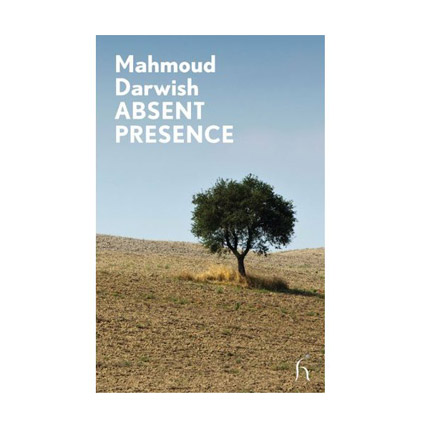
Mahmoud Darwish Absent Presence Hesperus CoverMine is a very short review in today’s Independent [in which you can also read Robert Fisk direct from al Tahrir Square, Cairo!] but then it’s a very short book and I couldn’t pretend that length diminished this version (in Mohammed Shaheen’s translation) of Darwish’s Absent Presence!

I’ve quoted Mahmoud Darwish’s own use of the word “baffling”, below. What is truly baffling is that in English there are almost as many translators as editions of his books. A lesser voice would have been neutered by this, but Darwish is a national writer on a par with any nation and simply deserves better.


Screenshot 2018-03-12 10.30.56

Absent Presence,

By Mahmoud Darwish

Lessons in life from the great divide

Reviewed by Guy Mannes-Abbott

Monday, 31 January 2011

Mahmoud Darwish was a giant of world literature.

This elegant edition of the last completed work before the Palestinian poet’s death in 2008 makes clear why. Absent Presence is a huge little book which defies conventional categorisation. It offers costly wisdoms Continue reading “on the biting wisdom of poets [two], mahmoud darwish”

on the biting wisdom of poets [one], mourid barghouti

What is happening, hopefully, in Egypt is truly momentous and it has been a long time coming, as MB says below; “When it happens, it will not have happened suddenly.” He is referring to a wider phenomenon across the Arab world, which is, I think, really the end [the real ending] of the post-Imperial age, the beginning of the beginning [the real beginning] of a new Arab autonomy and matching political culture. That is the prize. If Egypt completes its transformation, then it will be inevitable though not immediate and not in a single step. As such, it’s something that I’m only observing with respect and pleasure from just one ex-colonial capital!

A brief introductory quote from Tamim Barghouti’s related piece;

“Tunisia sent out the message that client regimes fall – that if we can drive the empires out, we will surely be able to drive out their vassals Continue reading “on the biting wisdom of poets [one], mourid barghouti”

on egypt, the price of a cab to the airport today

‘One of the chants in Cairo has been: “Gamal, tell your father that Egyptians hate you.”‘

“Christian or Muslim it’s not important, similar poverty similar concerns! Hosni Mubarak, Hosni Mubarak, the plane is waiting, the plane is waiting. Saudi Arabia is not far!” … A picture of an empty tear gas canister circulated, the zoom focusing in on ‘Made in USA’.’

Of course the state of Israel is confident that its quisling siege-partner will hold on to his throne with yet another display of force; about the only thing that Israel does or recognises. Reason enough, then!

M.I.A. once sang “What can I get for $10?” A cab to the airport perhaps? Go, go, go, go, go…

حول حكايات غزة

On Narrating Gaza

By Guy Mannes-Abbott

[With huge thanks to a, b and m -at least]


حول‭ ‬حكايات‭ ‬غزة

غاي‭ ‬مان‭-‬أبوت


عندما‭ ‬يتعلق‭ ‬الأمر‭ ‬بالحصارات،‭ ‬فإنه‭ ‬لا‭ ‬بد‭ ‬من‭ ‬الدقة‭ ‬من‭ ‬أجل‭ ‬الج‭ ‬دال‭ ‬حول‭ ‬الأ‭ ‬سبقية‭. ‬يبدو

المحاصرون‭ ‬في‭ ‬المكان‭ ‬بأكمله،‭ ‬وفي‭ ‬الوقت‭ ‬بأكمله‭ ‬كذلك‭. ‬المحاصرون‭ ‬هم‭ ‬ذاتهم‭ ‬على‭ ‬الدوام؛‭ ‬حيوان

قابع‭ ‬في‭ ‬الوقت،‭ ‬وبمروره‭ ‬يأسر‭ ‬المكان،‭ ‬ويتحول‭ ‬المكان‭ ‬إلى‭ ‬وقت‭ ‬بحد‭ ‬ذاته‭. ‬الهواء‭ ‬خانق،‭ ‬والنهاية

جماعية‭ ‬على‭ ‬كل‭ ‬حال،‭ ‬لكنها‭ ‬لم‭ ‬تقع‭ ‬قيد‭ ‬التفصيل‭ ‬بعد،‭ ‬أنت‭ ‬وحدك‭ ‬في‭ ‬ذلك‭ ‬العمق‭ ‬السحيق‭. ‬ينتمي

الحصار‭ ‬العسكري‭ ‬إلى‭ ‬عصور‭ ‬سابقة،‭ ‬إلا‭ ‬أنه‭ ‬لا‭ ‬يزال‭ ‬أكثر‭ ‬فجاجة‭ ‬لكي‭ ‬يبقى‭ ‬هناك،‭ ‬أي‭ ‬في‭ ‬غزة‭.‬

،‭ ‬غزة،‭ ‬حيث‭ ‬يقبع‭ ‬مليون‭ ‬ونصف‭ ‬شخص‭ ‬‭-‬معظمهم‭ ‬من‭ ‬اللاجئين‭- ‬تحت‭ ‬الحصار‭ ‬منذ‭ ‬حزيران‭ ‬۲۰۰۷

بسبب‭ ‬جرأتهم‭ ‬على‭ ‬تمني‭ ‬العيش‭ ‬في‭ ‬وقتهم‭ ‬وفي‭ ‬مكانهم‭. ‬فيما‭ ‬بدأ‭ ‬محاصروهم‭ ‬في‭ ‬۲۷‭ ‬كانون‭ ‬الأول

من‭ ‬العام‭ ‬۲۰۰۸‭ ‬،‭ ‬الاحتفال‭ ‬بمطلع‭ ‬العام‭ ‬الجديد‭ ‬مبكراً،‭ ‬منتشين‭ ‬بذروة‭ ‬الاحتفال‭ ‬بهدية‭ ‬من‭ ‬قذائف

الفسفور‭ ‬الأبيض،‭ ‬على‭ ‬مدارس‭ ‬الأطفال‭ ‬التي‭ ‬لجأ‭ ‬إليها‭ ‬الناجون‭. ‬على‭ ‬مرأى‭ ‬أعين‭ ‬عالم‭ ‬لم‭ ‬يرَ‭ ‬لذلك

.الأمر‭ ‬مثيلاً‭ ‬من‭ ‬قبل Continue reading “حول حكايات غزة”

on admiring a writer like marguerite young

I’m posting this as a note; part a/ so that I have to come back with a part b/…

She flitted through my mind, old interviews and some of my own early wonderment [triggered by a 1989 issue of the often useful Review of Contemporary Fiction, in this case one dedicated to MY, Kathy Acker and Christine Brooke-Rose] at her and her work, never quite resolved [mostly available in Dalkey Archive Press].

If the words US, 20th C. and utopian spirit don’t work in your mind -cults don’t count- then you ought to get to know MY…

That edition of RCF’s interview is here; “…abandoned utopias. I would say my theme has always been paradise lost, always the lost cause, the lost leader, the lost utopia.”

For now then, a fan page of photographs [why not?!] here.

And a Paris Review interview from 1977 is here

New editions of her books available in the UK today start at 0.1p… and $0.40 in the US; an unequivocally good sign!

UPDATE 5 Sep 2022!

She understood that all truly ambitious literary projects will unsettle the reading public and are, by their very nature, doomed to teeter on the brink of failure. “I think anyone who tries anything real—think Proust or Dostoevsky—risks being an absolute fool,” she told Charles Ruas in 1977, and she took this pitfall as a kind of dare: “But if you’re mistaken, be terribly mistaken!” I believe that Young was not mistaken. With Miss MacIntosh she succeeded in executing what I consider to be an entirely original vision, though her intent has often been neglected and misunderstood.’

I am avoiding elaborating my own thoughts by shamelessly linking you to the Introduction by MEGHAN O’GIEBLYN to the new DAP edition of Miss Macintosh, My Darling that was recently published online by N+1:

LINK: More Is More

PDF: More Is More | Online Only | n+1 | Meghan O’Gieblyn Sorry, have removed the PDF immediately, since everyone is linking to it not the online page! Will post when the link gives up…?

radwa ashour’s spectres, pamuk & pappe, november books of choice

Radwa Ashour’s Spectres [Atyaaf أطياف] is now available in English [Trans. Barbara Romaine] from Arabia Books in the UK and makes essential reading. Alongwith new books from Orhan Pamuk [HUP] and Ilan Pappe [Saqi], Spectres is one of the November Book Choices at Babelmed [at my suggestion]. Hooray for Babelmed; yet another reason to check it out…

UPDATE 03.xii.2010 A very short review of Spectres, commissioned by The Independent, will appear soon…

on not meeting edward said, who was right then and is right now

I enjoy unlikeliness and it seemed unlikely to me that Candia McWilliam would find herself in Edward Said’s memoir of his early life; Out of Place: A Memoir [Granta 1999]. That she does so in her own memoir [What to Look for in Winter: A Memoir in Blindness Cape 2010/Vintage 2011] is one of many endearing things about it and its author. Also a high recommendation for Said and his own memoir.

I spent a number of mornings in June this year running past one end of Edward Sa’id Street in Ramallah, actualising the way he and his work feature near the beginning of my adult life and have been returned to repeatedly ever since. I’m posting an old review I did for The Independent of his collection of pieces The End of the Peace Process: Oslo and after [Granta 1999 -out of print/PenguinRandomHouseUS 2001 -linked] [BELOW]. Read almost anything of Said’s [especially on the question of Palestine] and the absence of a voice like his today makes you weep.

Continue reading “on not meeting edward said, who was right then and is right now”