on gertrude [one], if i told him would he like it

Would he like it if I told him Gertrude Stein  1923
Beinecke Rare Book and Manuscript Library

For me this is where Gertrude’s wording, word-images, word-drawing of things, objects [Tender Buttons] and then people [Portraits and Prayers] really began to work. Really explodes. I love all of it of course, but this sounds like/conjures its object to me. It’s object is Picasso and this is the notebook manuscript of that gorgeous portrait of him that made its author so excited.

The Bienecke Rare Book and Manuscript collection of Gertrude and Alice’s is stunning. Sometimes I want to go and live there, burn my passport, unscrew the door handles, sit, read, be –eventually write. Meanwhile, Continue reading “on gertrude [one], if i told him would he like it”

حول حكايات غزة

On Narrating Gaza

By Guy Mannes-Abbott

[With huge thanks to a, b and m -at least]


حول‭ ‬حكايات‭ ‬غزة

غاي‭ ‬مان‭-‬أبوت


عندما‭ ‬يتعلق‭ ‬الأمر‭ ‬بالحصارات،‭ ‬فإنه‭ ‬لا‭ ‬بد‭ ‬من‭ ‬الدقة‭ ‬من‭ ‬أجل‭ ‬الج‭ ‬دال‭ ‬حول‭ ‬الأ‭ ‬سبقية‭. ‬يبدو

المحاصرون‭ ‬في‭ ‬المكان‭ ‬بأكمله،‭ ‬وفي‭ ‬الوقت‭ ‬بأكمله‭ ‬كذلك‭. ‬المحاصرون‭ ‬هم‭ ‬ذاتهم‭ ‬على‭ ‬الدوام؛‭ ‬حيوان

قابع‭ ‬في‭ ‬الوقت،‭ ‬وبمروره‭ ‬يأسر‭ ‬المكان،‭ ‬ويتحول‭ ‬المكان‭ ‬إلى‭ ‬وقت‭ ‬بحد‭ ‬ذاته‭. ‬الهواء‭ ‬خانق،‭ ‬والنهاية

جماعية‭ ‬على‭ ‬كل‭ ‬حال،‭ ‬لكنها‭ ‬لم‭ ‬تقع‭ ‬قيد‭ ‬التفصيل‭ ‬بعد،‭ ‬أنت‭ ‬وحدك‭ ‬في‭ ‬ذلك‭ ‬العمق‭ ‬السحيق‭. ‬ينتمي

الحصار‭ ‬العسكري‭ ‬إلى‭ ‬عصور‭ ‬سابقة،‭ ‬إلا‭ ‬أنه‭ ‬لا‭ ‬يزال‭ ‬أكثر‭ ‬فجاجة‭ ‬لكي‭ ‬يبقى‭ ‬هناك،‭ ‬أي‭ ‬في‭ ‬غزة‭.‬

،‭ ‬غزة،‭ ‬حيث‭ ‬يقبع‭ ‬مليون‭ ‬ونصف‭ ‬شخص‭ ‬‭-‬معظمهم‭ ‬من‭ ‬اللاجئين‭- ‬تحت‭ ‬الحصار‭ ‬منذ‭ ‬حزيران‭ ‬۲۰۰۷

بسبب‭ ‬جرأتهم‭ ‬على‭ ‬تمني‭ ‬العيش‭ ‬في‭ ‬وقتهم‭ ‬وفي‭ ‬مكانهم‭. ‬فيما‭ ‬بدأ‭ ‬محاصروهم‭ ‬في‭ ‬۲۷‭ ‬كانون‭ ‬الأول

من‭ ‬العام‭ ‬۲۰۰۸‭ ‬،‭ ‬الاحتفال‭ ‬بمطلع‭ ‬العام‭ ‬الجديد‭ ‬مبكراً،‭ ‬منتشين‭ ‬بذروة‭ ‬الاحتفال‭ ‬بهدية‭ ‬من‭ ‬قذائف

الفسفور‭ ‬الأبيض،‭ ‬على‭ ‬مدارس‭ ‬الأطفال‭ ‬التي‭ ‬لجأ‭ ‬إليها‭ ‬الناجون‭. ‬على‭ ‬مرأى‭ ‬أعين‭ ‬عالم‭ ‬لم‭ ‬يرَ‭ ‬لذلك

.الأمر‭ ‬مثيلاً‭ ‬من‭ ‬قبل Continue reading “حول حكايات غزة”

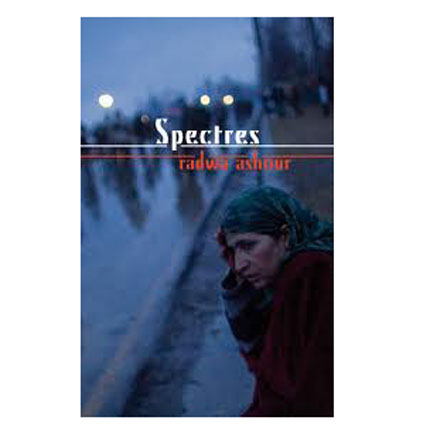
on radwa ashour’s spectres/atyaaf, in today’s independent

Radwa Ashour Spectres The Independent

Spectres (Atyaaf),

By Radwa Ashour

Trans Barbara Romaine

Pleased to see my very short review, shortened further to fit, of Spectres in today’s Independent: “Personal, Political and Painful” [UPDATE see below for full original review & an update from MW’s obituary for Radwa].

It ends;

Spectres combines invention, unofficial history and human abyss in an elliptical novel in which Ashour articulates an ethics rooted in Arabian and ancient Egyptian cultures. The result transforms a bleak constellation into a quietly stirring beacon. Spectres provides an irresistible companion to Barghouti’s memoir I Saw Ramallah, and a contrast to Elias Khoury’s more traditional Gate of the Sun. Spectres is a boldly original novel by an important writer whose exemplary work we need more of in English.”

I had a little more to say, but would only add now that the companionship with those two titles was predicated crucially on the words, “in translation”, thus referring to the disgracefully small pool of Arabic writing yet in English. As it stands it might be read as a weird and old-fashioned kind of valorisation, no? The word “demanding” has also gone from elsewhere, and again, I only mention it because though it’s indubitably great to see the novel celebrated in The Independent, it is the best of things; a demanding read in more ways than one.

My similarly tiny review of the Mahmoud Darwish’s rivetingly demanding Absent Presence (in the Mohammad Shaheen translation) will appear in due course… (UPDATE 2018: clean link here.)

Continue reading “on radwa ashour’s spectres/atyaaf, in today’s independent”

on ‘translated by’, the details…

Translated By

[CLICK image for details]

Curated by Charles Arsène Henry and Shumon Basar

Featuring Douglas Coupland, Rana Dasgupta, Julien Gracq, Hu Fang, Jonathan Lethem, Tom McCarthy, Guy Mannes Abbott, Sophia Al Maria, Hisham Matar, Adania Shibli and Neal Stephenson

*NB [UPDATE] The accompanying book will be published February 10th, details here and below; Continue reading “on ‘translated by’, the details…”

on appetite and a mystic chef, george steiner essays, new statesman 1995

George Steiner August 2008

Or; If Kafka were Hindu…

Every now and then I wonder about George Steiner. Mostly it’s positive wondering but something bugs me about him and it’s not what seems to bug most people I know or read that have met him or committed their view of him to print. Much of the latter is merely a distaste for overt intellect, especially a passionate ‘continental’ mind as well as distrust of the whole dynamic of translation, literally and metaphorically.

There are pedagogic and vulgar ego issues when it comes to Steiner but let me say in brief that I dissociate myself from the cynical Brit approach to him. What continues to bug me is essentially what bugged me when I committed myself to print 15 years ago [in the New Statesman, see below]; I hate it that he won’t credit Kafka, Mozart, even little me with the capacity -effort, hours/years of silent striving and error, the beauty of the attempt- to invent.

Instead, it wasn’t Kafka or Mozart it was “god”. Who? you might say. Religious faith is one thing [later, in Errata, he described himself as a “messianic agnostic”, which is anticipated in what I wrote below], but to misrecognise the grand smallness of human effort, endeavour and appetite is wrong as well as pitiful.

Steiner is a man with a good brain and that brain has famous and all too real appetite but it strikes me therefore as worse that he closes it all down when he approaches a peak to indulge in ‘god’-whistling instead. Such vacuity is the opposite Continue reading “on appetite and a mystic chef, george steiner essays, new statesman 1995”

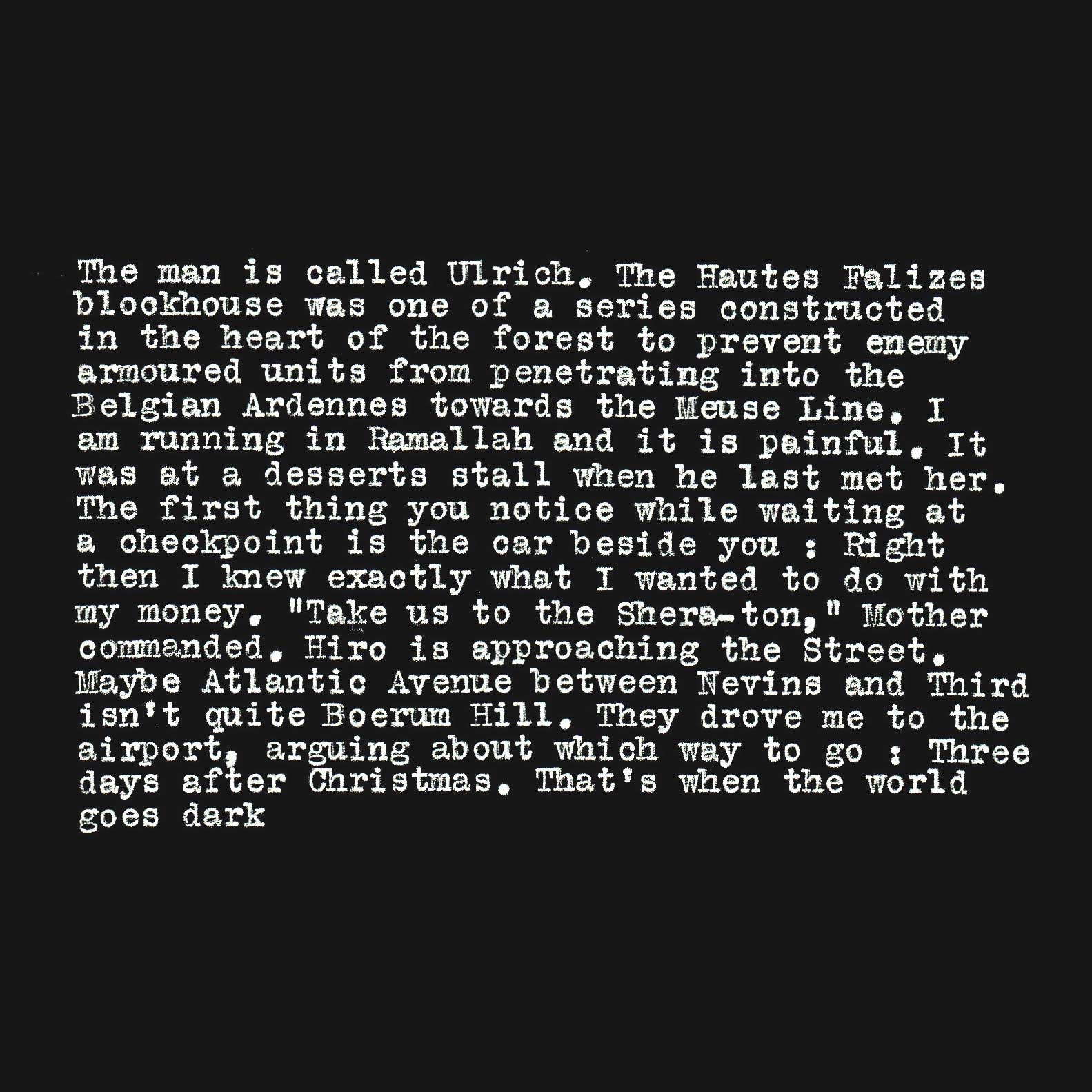
in ramallah, running 2010 [excerpt], in ‘translated by’ 15.01.11 – 09.02.11


Translated By

15.01.2011 – 09.02.2011

Architectural Association Gallery

36 Bedford Square, London WC1B 3ES

Private view event on 14 January  6.30–8.30

Curators Charles Arsène-Henry and Shumon Basar

You’ve entered the room. It looks empty, silent. Vinyl text on the wall, like an album track-listing. Writers’ names instead of bands.
You’ve been given a black pamphlet and an electronic device connected to a pair of headphones.
You’ll put them on. Pick a number. Press play. You look for the same number on the walls. You find it. Next to it, an image. Beside there is a seat. You sit. On a beat up office chair dredged from a river. You listen. And you start travelling. You’re on Atlantic Avenue, between Nevins and Third. It’s Brooklyn. 1971.
The voice stops. You go for another track, another chair, a different place. Now on a little stool, you follow a six-year-old girl’s voice in your ears. You’re lost in the Sheraton Hotel. An Aztec spaceship in Doha’s desert.
It will last for 11 tracks. Through Tripoli, Brixton, Ramallah. Sofia, The Metaverse. Ardennes forest. A garden.
Until West Vancouver. Where the world is ending.

NB I have a text, a small excerpt from In Ramallah, Running 2010, in this show and publication in happy company… details to follow.

I’ll also update during January 2011 with news on the book itself as it progresses towards publication which is now scheduled for October 2011.

on admiring a writer like marguerite young

I’m posting this as a note; part a/ so that I have to come back with a part b/…

She flitted through my mind, old interviews and some of my own early wonderment [triggered by a 1989 issue of the often useful Review of Contemporary Fiction, in this case one dedicated to MY, Kathy Acker and Christine Brooke-Rose] at her and her work, never quite resolved [mostly available in Dalkey Archive Press].

If the words US, 20th C. and utopian spirit don’t work in your mind -cults don’t count- then you ought to get to know MY…

That edition of RCF’s interview is here; “…abandoned utopias. I would say my theme has always been paradise lost, always the lost cause, the lost leader, the lost utopia.”

For now then, a fan page of photographs [why not?!] here.

And a Paris Review interview from 1977 is here

New editions of her books available in the UK today start at 0.1p… and $0.40 in the US; an unequivocally good sign!

UPDATE 5 Sep 2022!

She understood that all truly ambitious literary projects will unsettle the reading public and are, by their very nature, doomed to teeter on the brink of failure. “I think anyone who tries anything real—think Proust or Dostoevsky—risks being an absolute fool,” she told Charles Ruas in 1977, and she took this pitfall as a kind of dare: “But if you’re mistaken, be terribly mistaken!” I believe that Young was not mistaken. With Miss MacIntosh she succeeded in executing what I consider to be an entirely original vision, though her intent has often been neglected and misunderstood.’

I am avoiding elaborating my own thoughts by shamelessly linking you to the Introduction by MEGHAN O’GIEBLYN to the new DAP edition of Miss Macintosh, My Darling that was recently published online by N+1:

LINK: More Is More

PDF: More Is More | Online Only | n+1 | Meghan O’Gieblyn Sorry, have removed the PDF immediately, since everyone is linking to it not the online page! Will post when the link gives up…?

preface to epitaph, anne carson and nox in london nov 2010


Anne Carson Iceland 2009 [Photo Einar Falur Ingolfsson]

[Notes on Carson’s London reading of Nox, a couple of years after the last advertised event -in the wake of Decreation and also at SBC- was cancelled. They posted themselves raw a few days ago, here they are at least spell-checked…]

The first and easy thing to say about my obvious need to catch Anne Carson reading in London [Southbank Centre Poetry International Festival opening event Tuesday Nov 3] is that having gone only to see/hear the most significant poet in the English language actually read, perform, be in public the whole event was an instructive delight.

Carson was the last on of 6 poets, all of whom were worth seeing/hearing -if not memorable as such or as yet- but notable for me Continue reading “preface to epitaph, anne carson and nox in london nov 2010”

on getting well soon, amin maalouf’s origins 2008

AM: “what I would like to do is leave ajar the door to my office”


Amin Malouf had only just got started with a nice blog [here] before that same blog announced on March 13th 2010; “As some of his friends already know, Amin has had some health concerns that have kept him away from this blog for the last few months. He hopes to be back soon, and he extends to everybody his heartfelt apologies and his best regards.”

Wondering today if there were news and hoping it might be good news; recovery and a return to writing even, I remembered that I wrote a very short review of Origins, his last book to be translated into English, for The Independent and decided to post it below.

Meanwhile, enjoy this [inevitably contentious yet intriguing] page of his;

My Web of Words;

1-Alcohol. 2-Turkey. 3-Orange. 4-Roumi. 5-Greek.  6-Egypt. 7-Franc. 8-Mattress. 9-Baghdad. 10-Table.  11- Punch. 12-Rose. 13-Apricot. 14-Hazard

His UK publisher’s page for Origins is here.

Screenshot 2018-03-12 10.30.56

Continue reading “on getting well soon, amin maalouf’s origins 2008”

sparks of the one and only muriel in rome 1971


CLICK still above to watch interview

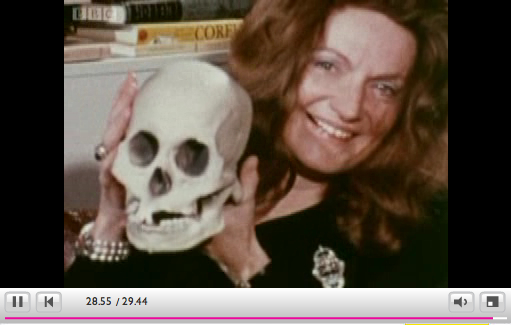
New Directions, one of the -if not the- only unashamed publishers of books left, send out a newsletter which currently flags up their edition of Not To Disturb [1971] and a forthcoming Curriculum Vitae [1992] and links to Maud Newton’s blog which itself links to this gorgeous interview with a profanely regal Muriel in that palatial apartment in Rome [cf Martin Stannard’s recent biography]. It’s a very nice way to spend 29 minutes and 44 seconds…

CV is one of my favourite of her books, one of my favourite books altogether [republished in 2009 by Carcanet here]. I remember being stunned by its clarity of recall of an early life in Edinburgh. It’s all there, down to the wood of the chairs in each classroom kind of detail, an all-present narrative prose that contrasts almost completely with my own inevitably elliptical memory and what -to risk baying English laughter- I have to call precisely, my equivalent poem [very possibly a bad poem, but I’m being exact rather than qualitative]. Incidentally, claiming Spark is one of the few times that conventional thinking has any appeal to me. If a notion of patrilineage were a substantive approach to life, I’d simply be a Scot -albeit via lengthy colonising detour -which rather underscores it…

Continue reading “sparks of the one and only muriel in rome 1971”