A Revolution Every Day: Elias Khoury interview around Bab al Shams/Gate of the Sun, 2005

elias-khoury

Elias Khoury’s Yalo was one of my stones stepped in 2009 [see Categories] and it’s on the long-list for The Independent’s Foreign Fiction Prize, announced here. Competition is stiff, needless to say, but I hope it wins.

71OpE2rW20L._SL1170_I posted a link to the interview-based piece I did around the seminal publication in English of Bab al shams [Gate Of the Sun] in 2005 -the first of its kind in English- and now post it below. Gate of the Sun is a monumental work of fiction; a brilliant creative achievement which is both important and highly accessible. That is, it’s so compelling that there’s no excuse for not realising the necessity of reading it.

In the US Archipelago Books is promising two new Khoury titles; a novel called White Masks in 2010 and another novel As Though She Were Sleeping in 2011. There are already two more works of fiction published in the US by university presses. I’m looking forward to the day when his critical writing becomes available to the English-speaking world.

Wherever you start with Khoury [an earlier novel, Little Mountain Collins Harvill 1990 is out of print] you’ll be hungry for more.

Screenshot 2018-03-12 10.30.56

Elias Khoury: Myth and memory in the Middle East

Lebanese writer Elias Khoury is one of the leading lights of Arab literature. Guy Mannes-Abbott meets him

Friday, 18 November 2005

Elias Khoury is the kind of writer who wins the Nobel Prize for literature to sneers from the English-speaking world. When the Egyptian novelist Naguib Mahfouz was greeted in this way in 1989, the late scholar and activist Edward Said remarked sagely that “Arabic is by far the least known and the most grudgingly regarded” of major world literatures. At the same time, Said pointed to the future, celebrating the promising achievements of Khoury – a “brilliant figure” – and Mahmoud Darwish: a Lebanese and a Palestinian writer respectively.

The word “brilliant” is etched across Khoury’s new novel, Gate of the Sun (Harvill Secker, £17.99) and on my mind when we meet in London for lunch. His reputation as a novelist, critic, commentator, editor and academic with real political commitment is formidable. Khoury came to prominence in Lebanon – and therefore the Arab world – in the mid-1970s. Still in his twenties, he was working in the Palestine Research Centre, editing the literary pages of its journal and writing his second novel, Little Mountain, which re-worked his experiences in the Lebanese civil war of 1975-1990 almost as they happened.

I feel more Beiruti. If you are a Beiruti, you are an Arab. You are open to all types of cultures, and to innovating in the Arabic culture at the same time.

“It’s meaningless!” he thunders, when I ask him what it means to be Lebanese. Then, speaking rapidly, he develops a characteristic response which ends with a modified repetition of the phrase. In between, he sketches a history of Lebanon’s many civil wars since the 19th century, describes similarities in dialect and cuisine between Syria, Lebanon and Palestine, and asserts that “I feel more Beiruti. If you are a Beiruti, you are an Arab. You are open to all types of cultures, and to innovating in the Arabic culture at the same time. You are in the Lebanese dilemmas and you are so near to Palestine”. So you feel “that the Palestinian tragedy is part of your life.”

By this he means sheer physical proximity – “It’s a matter of 100 kilometres” – but also that he has grown up with the Palestinian refugees who arrived in 1948, the year of his birth. All of this is the subject of the epic Gate of the Sun, which has already been cheered in Arabic, Hebrew and French editions during the seven years it took to arrive in this elegant English translation by Humphrey Davies.

Gate of the Sun, or Bab al Shams, is an attempt to render the Palestinian nakba – or “catastrophe” – of 1948 and its tortuous aftermath.

Gate of the Sun, or Bab al Shams, is an attempt to render the Palestinian nakba – or “catastrophe” – of 1948 and its tortuous aftermath. Specifically, it contains the stories and lives of people whose ancestral villages in Galilee, now in northern Israel, were “wiped out of existence”, forcing them into desperate flight by land and sea to Lebanon.

“Actually,” says Khoury, “I was writing a story about Galilee, because it’s in-between” and home to many Palestinian writers, including Darwish. “I was not writing a history of Palestine. Of course, many ask why it was a Lebanese not a Palestinian who wrote this story. I really don’t know. What I know is from the experience of the Palestinians I worked with,” he explains.

“actually this is something unbelievable.”

The nakba of 1948 was “a shame, a total defeat; it’s a disaster, a real personal disaster. There are stories here about the woman who left her child, about a woman who killed her child. So it’s not easy to talk about. The Palestinians did not realise, and if they realised they did not believe that this could happen, because actually this is something unbelievable.”

Khoury had the initial impulse to turn stories he heard in refugee camps into a memorial narrative in the 1970s. He spent much of the 1980s gathering “thousands of stories” before writing this extraordinarily accomplished novel. Gate of the Sun is essentially a love story set in a world turned upside down. It involves a dying fighter called Yunis and his wife Naheeleh, an internal refugee in Galilee, whose relationship forms during stolen visits across the border to a cave renamed Bab al Shams. The cave is “a house, and a village, and a country”, and “the only bit of Palestinian territory that’s been liberated”. It produces a “secret nation”: a family of seven children who have borne four more Yunises by the end of the book.

The cave is “a house, and a village, and a country”, and “the only bit of Palestinian territory that’s been liberated”.

However, this is no parable. For Khoury, “Yunis, of course, is a hero. He used to go to Galilee, he used to cross the borders… but in the end we discover that he was nothing, that Naheeleh was this whole story; her relationship with the children, and how she actually defended life. In the refugee camps I met hundreds of women like Naheeleh. Then it’s no more a metaphor. It’s very realistic.”

This reality is the “revolution of actual work carried out by our mothers”, which the poet Mourid Barghouti articulates so well

This reality is the “revolution of actual work carried out by our mothers”, which the poet Mourid Barghouti articulates so well in his memoir I Saw Ramallah. It is “realised every day, without fuss and without theorising”.

Khoury’s story of love and survival is told by Khaleel, an untrained “doctor” at a redundant hospital in Shatila refugee camp. Shatila was the site of a notorious massacre in 1982, overseen by an Israeli army commanded by Ariel Sharon. During the months that Khaleel attends to Yunis’s lifeless body, he stitches together his honorary father’s stories in order to bring him out of coma. Gradually, Khaleel’s own story emerges: of his love for a female fighter called Shams, and his experience of the camp massacre.

If this evokes the Thousand and One Nights, in which Scheherazade tells stories to keep herself alive, it’s the structure and act of telling that are important. Edward Said praised Khoury’s innovations in Little Mountain and the author takes the compliment, but says that “when I came to write Little Mountain, I discovered that real experimentation is not intellectual”. Instead, you have to “go deep to your own experience”.

These years involved “a very deep engagement about what is justice, what is a human being and what is life”.

In 1967, aged 19, Khoury travelled alone to Amman to join the Palestinian resistance after Israel occupied the West Bank and Gaza. In 1970 he finished his studies in Paris before writing his fictional debut, a nouveau roman. In 1975 he fought for revolutionary change in Lebanon, his disillusionment captured elegantly by Little Mountain. These years involved “a very deep engagement about what is justice, what is a human being and what is life”.

“I don’t think there is any story we live from the beginning to the end,” he says.

It is this experimenting with life, combined with such testing experience of it, that makes his writing less “experimental” in the literary sense than naturalistic. Crucially, he developed a faith in oral narratives; encompassing both the colloquial forms used in telling a story, and the non-classical type of Arabic that such stories are told in. “I don’t think there is any story we live from the beginning to the end,” he says. In this novel, “the structure is oral telling – openness. That is, you begin a story, you enter another story, and then you come back”.

In the novel, Khaleel complains about fugitive “snatches” of story that he’s struggling to remember and narrate. He blames the influence of tarab, the ecstasy generated by the rhythms of Arabic music and – by extension – poetry for the sidelining of descriptive skills. Khoury elaborates: “It’s repetitive, but every time you repeat, you change. Also in prose you create music, repeating the same story three, four, five times, and every time it’s a very slight difference. This is the Thousand and One Nights, this is the musicality of the oral and this is tarab.”

One of the results is that it produces “suspense from a totally different perspective. If you want to know what will happen to Yunis, he will die, so close the book and go home; but it’s another type of suspense.” It is this rhythmic accumulation of story that makes Gate of the Sun so unexpectedly compelling. It’s also this democratic form of telling which has enabled Khoury to approach the subject; to piece together fragments into a masterfully executed novel. The resulting mosaic of suggestive truths complicates any simple metaphorical reading while returning over and over again to discrete realities.

The Israeli project is to make a myth into reality. This is the problem.

“Reality,” he summarises, “can become metaphor or a myth. But a myth, if it will become a reality, it’s the most savage thing in the world. The Israeli project is to make a myth into reality. This is the problem.”

Khoury’s iteration of inconvenient realities is rigorously ethical. It is there in his responsibility towards Jewish history as well as to Palestinian dispossession, and in his novel’s investigation of love’s work. It informs his efforts to modernise Arabic by means of colloquial speech, and his commitment to grassroots democratic movements in Lebanon and Syria.

Khoury’s experience of life has generated a sophisticated optimism. He takes the long view, having resettled in the ancestral home in Beirut from which he was driven in the 1970s. He is both worldly and warm, a man of heart as well as passionate intellect. Nothing is off-limits and he answers every question fully even though we have, literally, eaten into preparation time for an evening reading. Before parting, though, I must ask the author of Gate of the Sun about the theory that “to narrate is to return”.

These paradoxes and “pleasures” find potent resolution in Gate of the Sun. It’s a novel that will outlive us.

“No, I think that to narrate is to reconstruct, to appropriate but,” he breaks into a story from one of his novels before resuming, “one of the biggest, er, pleasures of the Palestinians was to regain your name, to be Palestinians. And once you regain your name – and I think this is narration, to regain the name – then you prepare yourself to go: that is, to create a Palestine, not to return to a Palestine which was.” These paradoxes and “pleasures” find potent resolution in Gate of the Sun. It’s a novel that will outlive us.

Biography: Elias Khoury

Elias Khoury was born in Lebanon in 1948, to an Orthodox Christian family in the East Beirut district known as Little Mountain. As a sociology undergraduate, he volunteered for Fatah, the military wing of the Palestinian revolution. During the 1970s he worked in PLO organisations in Beirut, and helped found the journal al-Karmel with the poet Mahmoud Darwish. He speaks Arabic, French, English, Syriac and “a little Hebrew”. Author of 11 novels, four non-fiction books and three plays, he also scripted a film of Gate of the Sun. The novel is published by Harvill Secker this month. Khoury is now an editor with the Lebanese newspaper An-Nahar and Global Distinguished Professor at New York University. He lives with his wife in his great-grandfather’s house on Little Mountain.
james salter; readers revenge & last night 2006

James Salter photo

I wonder if anyone really cares or wants to linger with what Norman Mailer thought or wrote about sex, nor what any of the Jonathans haven’t thought or written about it.

I’m intrigued however by the way that Kate Roiphe’s much-blogged piece in the NYT left out any mention of the great and complex James Salter’s thoughts and writings about it. Of course, it’s because he doesn’t fit the schema; old existential roisterers and silly braggers vs new pseudo-feminised feyboys/merchants of self-mortification.

The key line is this one comparing the old with the weary:

“In contrast to their cautious, entangled, ambivalent, endlessly ironic heirs, there is something almost romantic in the old guard’s view of sex: it has a mystery and a power, at least. It makes things happen.”

Roiphe’s not-mentioning Salter maps too neatly over the way that his many non-mentioners perceive him as nothing more than a 2-D ClassicMan served in pricey after/over dinner sauce. Or as marginal old-school, perhaps? Instead, sticking with the schema, I think that Salter knows that sex can make things happen, but that those ‘things’ involve plenty of entangling ambivalence too, no? [Who isn’t weary of cautious irony?]

Salter’s non-readers also think of him as typical New Yorker product when, just for instance, he was far too much, too singular, too difficult for the New Yorker for decades while producing brilliantly crystalline short stories [hunt down Dusk and other Stories]. The same non-readers managed to dampen the fact that Salter’s fiction is now in Penguin Modern Classics where it belongs [amongst books not to be approached with cliché, at least] and what isn’t is well published in the UK in Picador paperback.

So, while for many years it was hard to get at or read his classics; A Sport and a Pastime [published in the UK 20 years after the US!], Light Years and Burning the Days, it no longer is. At the same time, his almost impossible to find earlier or less concentratedly Salteresque/Salterine books, The Hunters and Solo Days are now also in print. Easily available, not to be missed.

Readers can get one over critical and consensual incuriosity and, frankly, ignorance, by reading books like Solo Faces and forming their own judgment on exactly how good it is in Salter’s mini canon of greatness. A tip; get over the first few pages up on that church roof and you’ll find yourself finishing it at a sitting -on a ledge thousands of metres above the ground.

Salter’s non-mention in the story of 20th American sex-writing came at the same time, slightly unfortunately, as the issue on DVD on a film he scripted for Robert Redford, Downhill Racer. I haven’t seen it yet but the combination demonstrates a rare breadth of ability  no less and generated attention in places like GQ on the one hand and Slate on the other.

Any trigger to read Salter is welcome, but I think GQ’s notion that he is [‘merely’] a great sex writer is wrong. No no it’s more than that; he’s a great writer of desire, in the theoretical and quotidian sense. This is why his 50s, 60s, 70s and 80s writing feels so alive, generating ambivalence with a very particular nakedness of the spirit -and very much more.

So every time Salter is not-mentioned, take the reader’s revenge and enter a world founded not on comfortable certainties, leering vantage points or, I’m afraid, sexual possession/disgust, but on what a character in his earliest fiction describes as “indigenous doubt”; a world of conflicting desires, ideas, roles, intentions, hopes and expectations. One very like how we all experience being alive in 2010, no?

I’m posting a short celebratory review I wrote as Salter’s second collection of stories, Last Night, was published in the UK in 2006, when his other work was still very hard to get hold of.

Early in 2007 he was in London and gave an irresistible reading at the LRB bookshop. By then I’d drafted a highly singular and -dare I say- pretty authoritative essay called Meeting James Salter.  I sent my 7000 word essay to one or two people with sufficient appetite in London. That led indirectly to me actually meeting JS and then to him mailing substantial comments and factual corrections to my essay.

I haven’t succeeded -or tried hard enough- in ‘placing’ Meeting James Salter, surprise, surprise. The only journal in the UK that publishes at any such length told me they’d done something on him recently, meaning an ill-read review from the this-man-is-a-sexist-cliché school in 2004. Such things are telling if forgivable for a young critic; not so for the well-seasoned publication itself.

For now, anyone interested in reading or publishing my essay can email me at the address in About: queries [at] g-m-a [dot] net.

Screenshot 2018-03-12 10.30.56

Last Night. By James Salter

Penetrating tales about life from an American master of fiction

Review by Guy Mannes-Abbott

Thursday, 30 March 2006

“Aplomb” is a favourite word of James Salter’s. He praises Virginia Woolf for hers, adds it to the physical glories of a busy mistress, and, in Nedra Berland, heroine of his novel Light Years, wrote a study of it. He uses it like this; “I liked the way he spoke, the speed of his conclusions, the breadth of his scorn, the exactness of his references. Also his aplomb.”

Famously, albeit not famously enough, Salter is the Jewish-American fighter pilot and film writer/maker, transformed in mid life into a master of ecstatic prose fiction and non-fiction. Even this legend has a singular footnote containing two early novels, straighter accounts of airborne daring-do, recently revised. Literary canons are risible, as Harold Bloom’s choice of Light Years and Solo Faces for his parade, The Western Canon, demonstrates. However, Salter has written three books that everyone should read before they die; A Sport and a Pastime [1967], Light Years [1975] and his book of recollection, Burning the Days [1996].

Death and the life achieved against it is Salter’s obsession. As a fighter with more than 100 missions over Korea in the 1950s you might expect as much. Similarly hard earned experience helped make Solo Faces a brilliantly authentic portrait of mountaineering. Both pursuits promise much and demand absolutely everything of you. Aplomb incorporates this dauntlessness as well as Nedra’s “self conquest”, a freedom gained only by risking all. Otherwise, she adds, “life is only appetites until the teeth are gone.” Salter’s world, most obviously the idyll memorialised in Light Years, may appear exclusive but is shaped by “lives achieved in agony”, gamblers who have lost, a peculiar dissidence.

All of this is exemplified in his new collection of ten short stories written since the early 1990s. Last Night follows Dusk and other stories, a collection which began with Am Strande von Tanger from 1968. From the first Salter was fully present in stories which have all the precise interiority and penetrating perspective of his novels. They share something else. At least half of Dusk’s stories are milestones of the form, yet were spurned by The New Yorker, for instance, and remain out of print. His novels have struggled to find publishers, only to immediately fall from view. Now, two of them will shortly become Penguin Modern Classics.

Last Night opens with Philip and Adele’s marriage, their fifth -jointly. Around a Salteresque dinner table with friends, Philip resists the consensual reaction to news of infidelity. Then, while Adele guts her husband’s failed marriages he holds to their joys; he’d do it all again. Outside Adele finds him staring at a comet; “It won’t be there tomorrow. One time only.” She turns away, shrinking as she recrosses the lawn “reaching first the aura, then the brightness, then tripping on the kitchen steps.”

Elsewhere a young couple’s agreement to correct irritating flaws in each other with a ‘give’ founders when Anna asks Jack to “stop the sex” with Des, their semi-resident poet and child’s inspired friend. In Platinum we encounter the downside of aplomb, when Brian and his powerful father-in-law find themselves sharing the “forbidden happiness” of busy Pamela. In Bangkok, a book dealer shucks off a former lover’s fantasy offer, preferring his settled existence: “It was not a pretend life.”

Salter has described finding part of “one’s never complete mosaic … abroad” -as seductively elaborated in A Sport and a Pastime. Similarly, his characters are made whole by their secrets and deceptions. This is true even of Walter Such in Last Night -first published in The New Yorkerwho is to administer a lethal injection for his terminally ill wife, Marit, after dining with their young female friend. Classic Salter and as good as living writing gets, the story collides with a comet, ricocheting unpredictably.

Last Night tops a beautifully weighted collection fully the equal of Dusk. These stories, like Solo Faces, have been written with the sun directly overhead, in contrast to the angular, retrospective veils of evening light which are so much Salter’s style. The recognisable present occasions some stylistic dilution but no loss of exactitude or exquisitely crafted velocity. Last Night is an urgent and deeply gratifying reminder of what reading is for.

PICADOR, £14.99. ORDER FOR £13.99 (FREE P&P) ON 0870 079 8897

gujarat, while baroda burns; TANK magazine 2004

while baroda burns

by Guy Mannes-Abbott

In 2004 TANK reprinted extracts from my extensive notebooks on Gujarat in western India.  They’re taken from the days of “mass massacres” when I was locked up under curfew in my room on the 4th floor of a hotel, forbidden to leave the building or even to go as low as the 1st floor.

The whole story of witnessing state-sponsored pogroms while trapped with Bhupen Khakhar in his car on the outskirts of Gujarat’s second city and its various contexts form part of my forthcoming book A Gram of Gujarat. A part, but only a part. A part along with many other equally vivid, penetrating and suggestive parts! Taken together they provide a unique insight into Gujarat and contemporary India which enables a proper grasp of these signal events.

These particular extracts reflect something of the raw experience of being trapped in a room [tall building, complicit city and bone-shaking witness] looking out of a window onto a building usually only ever animated by women. I watched discretely as the traditional rhythms of everyday life went on in an abstracted way. Above rose black impressions of the terror being inflicted on Baroda’s old city; common, abstract again [literally framed by my window] but presumably at least as intense as those I’d been caught in. Otherwise; silence.

After two or three days it occurred to me to take photographs [some of which are poorly repro’d here], as the oddity of life in the building and the realisation that the smoky evidence was likely to stop if or when the army eventually took control of the city dawned. Obviously I was as visible as the people opposite and didn’t want to impose on them, so each image was snatched and for me condenses hours of the life it captures. Similarly, I only took one image of the smoke at the end and with confused reluctance; a feeble effort all around.

The politicians and authorities responsible for the massacres believe that the subcontinent is both Fatherland and Holyland; that the very dust is bound up forever with the dharma/spirit of each and every Hindu. Hindutva is a terrifying ideology, drawn from European fascism and Nazism specifically and these “mass massacres” a direct and logical result of it. Followers believe that a Hindu never loses their dharma and so India’s 150 million Muslims must recover theirs and renounce Islam -or they can ‘leave’.

Press PDFS to Enlarge

This is the same India that has a secular constitution and which was once the proud centre of the Non-Alignment movement but which has never reconciled itself fully with several centuries of Islamic dominance and conquest. Not even though a consequently rich Islamic heritage forms just one part of the subcontinent’s definitively syncretic culture. This is part of the specificity of hindutva, and why it’s worth reading VD Savarkar on the subject and understanding what there is of substance beyond the shudderingly crude race hatred that so corrupted his mind and thought.

The same India where some of the nicest people I met, seasoned secularists of various stripes, were the most complacent/deluded about the pressing actuality. It’s distressing to listen to someone making fun of their own Muslim upbringing, poo-pooing any intimacy with Islam or its wider culture, laughing at the notion that they would have any insight into such a subject when their own work, memoirs and even academic cv contradicts them. Frustrating when the point is simple; ‘they’ perceive you to be Muslim whatever your self-image. This is the nature of racism, fascism and lest we forget Nazism specifically.

Any conversation of that kind contains the unmistakable presumption that as a Foreigner I can’t possibly understand. It’s all a very complex, internal affair and only one of us can really appreciate it. In such instances they were clearly mistaken. In one exemplary case, when politely listening to an excited account of brief passage through a ‘secret’ outpost on the edge of the Rann of Kutch, I kept to myself the knowledge that I’d ridden out to the same particular outpost four times, found a floor to stay on inside its walls, a cave to sleep in beyond them.

Such an intense, ‘deep’ encounter with place and people was the yardstick I developed , which is why I was able to contextualize just how much or little right-minded, out of touch secularists of this kind understood about their neighbours [and to contextualise their insulting and short-sighted presumptions]. It’s for this reason that what happened to that particular individual and to other Muslims [religious or otherwise] across the State was profoundly shocking to me, but not a surprise. This is why it all made a horrible kind of ‘sense’.

Whilst ‘Metro’ secularists disown, deny and delude themselves about what “mass massacres” meant for India, I’d been encountering it in mud and urban kitchens, chai stops in deserts and forests, main roads, side streets and camel tracks, mandirs, dharamsalas and masjids, chellahs, tirths and tuks, Bohra wads, mohallas/pols and Societies, forts, havelis, universities and cool alleyways across the state. I listened to barots and charans, dalits and Brahmins, shia and sunni, professors and ‘local’ historians, ram sewaks and their Big Men financiers, MPs and MLAs, victims and perpetrators, writers and architects. I’d witnessed what it meant for months before this discreet horror and for months afterwards.

Understanding requires a real engagement with a wide range of things, places, peoples and times. It requires the articulation of distinct and interrelated elements in an authoritative portrait of a people and their place. Such a portrait would enable understanding of these particular events but also a much wider context. If it succeeded it would reveal the interiors of  Gujarat as a whole and provide a unique insight into subcontinental India. This is what I’ve attempted to do with A Gram of Gujarat.

susan sontag fn. david’s guide to getting up the guts to try

Feodor’s Guide

Dostoevsky By Joseph Frank

Princeton University Press

Volume 1: The Seeds of Revolt, 1821-1849; $16.95 paper

Volume 2: The Years of Ordeal, 1850-1859; $15.95 paper

Volume 3: The Stir of Liberation, 1860-1865; $16.95 paper

Volume 4: The Miraculous Years, 1865-1871, $35

By David Foster Wallace

Continue reading “susan sontag fn. david’s guide to getting up the guts to try”

gujarat, on silence and massacres; raj kamal jha fireproof 2007

On Silence and Massacres.

Raj Kamal Jha is one of the most interesting and risk-embracing of his generation of Indian writers of fiction in English. His report on the mass murders and vast internal displacement of Muslims in the state of Gujarat in the spring of 2002 was brave in the context; a nuked up hyper-Nationalist government led by the same party which ruled in Gujarat at the time, the Nazi-inspired BJP.

When he came down from Delhi -albeit two months later- he ‘joined’ those of us not targeted by the officially sanctioned killers but trapped in extended curfews, in my case for days on the 4th floor of a building in central Baroda. Jha wrote a stunned and peculiarly angular piece for The Indian Express, a cutting from which I’ve scanned and posted. His discoveries as a “riot tourist” [‘riot’ is a common euphemism in India for racist massacres or ethnic cleansing, like ‘conflict’ elsewhere] inspired the novel Fireproof, which I reviewed for The Independent below.

Jha reprimanded his readers [urban, majority-community, new-India class] in the mildest of terms; imagine the surreal boot on the other foot. He was addressing those who quietly allowed this to happen, however, and if you won’t credit him with bravery at least understand the relative unusualness of his addressing a class of readers impatient with older Indian verities like those espoused by Nehru -let alone Gandhi! [both of whom happily allied themselves with the chauvinist Vallabhai Patel, India’s ‘Iron Man’ from Gujarat.]

Elsewhere, the hero of the day was Siddharth Varadarajan who expressed his visceral horror in regular reports for the Times of India, while the heroine was Dionne Bunsha reporting for Frontline magazine, [see her site/blog]. Varadarajan also edited the first and still best book on the massacres; Gujarat; The Making of a Tragedy [Penguin India 2002] [look inside] drawing in part on an excellent issue of Seminar [‘Society Under Siege’ from May 2002 is online but not link-to-able] and has a blog here.

What happened in Gujarat is not a matter of substantive dispute [though it’s ostensible trigger, the fire in a train carriage outside Godhra is, even though extensive investigations concluded that the fire which began within the carriage was a tragic accident], there are plentiful witness reports, accounts, proofs, burnt out buildings and neighbourhoods, bodies, refugees and subsequent changes across the state. What happened persuaded urban Gujaratis in particular to reward the government of the day with two further election victories.

So despite what happened no-one has been held to account: Narendra Modi remains Chief Minister of Gujarat. He is the BJP’s only current ‘star’ and commands a state that is India’s real powerhouse once more. A state that is as ever leading the way in new India, for good and ill, and rehearsing what the coming global power will look like. Modi’s mentor, LK Advani, is also a Gujarati MP and the octogenarian leader of a much humbled BJP. However, India’s national elections are three years or so away -if the present Congress administration lasts out its second term- and everybody loves a ‘winner’.

I witnessed some of what happened in Gujarat; I saw armed policemen in uniform holding one end of a street that was being systematically ‘cleansed’ for the second time in 24 hours by a group of 25-30 neatly dressed men, vehicles used to block the various roads and escapes routes and set on fire, as remaining stores, shacks, gadis/trolleys and possession of the neighbourhood Muslims were being dragged out onto the road within sight and smell of the same uniformed accomplices and set on fire.

I witnessed it from inside Bhupen Khakhar’s car as we were trapped by these same men in a near-deserted Manjalpura, Baroda, during a one-day bandh or shut-down. They weren’t after us at that time [though BK’s paintings and sexuality had been the focus of their maddened hatred] and we managed to escape through a series of already laid road blocks and away from the scene before the neighbourhood mosque was burnt down with three men trapped inside it. I was close enough to look hard into their faces as they indulged their fantasies and it’s a sight I’ll never be able to forget.

Then I witnessed the silence, the smoke stacks and discomfort at my front-row presence on the few faces I glimpsed in the coming week locked away [anger, too, once the curfew relaxed]. A silence indistinguishable from the way that such a massacre is possible in India, because what the black milk rising from the eery quiet of Baroda beyond my window proved was that this was long coming and represented something that didn’t need words.

Gujarat’s “mass massacres” only needed silence;  official permission, wider complicity, neatly printed official records of who lived where, who exactly owned what and enabling nods … ram ram

NB Incidentally, I don’t relish criticising India from afar; my view is simply that Modi should face justice in his own country. However, Indian justice is staggeringly slow and precedent  suggests that even if it catches up with Modi before he dies it won’t have any bite. Indeed, it is as likely that he might be the next PM or PM-maker. Things do change however; the case is very much live at this very moment [see here for example].

I support universal jurisdiction; if Modi wants to travel he should be willing to face trial wherever he lands, just like Pinochet and forces’ sweetheart Tsipi Livni and gang. Meanwhile, though, he rule’s India’s most interesting state and is free to roam a subcontinent of bottomless marvels. I remind you that Modi’s BJP forged alliances with the US and Israel when in power: sometimes it’s necessary to tell the truth whatever the distance…

Screenshot 2018-03-12 10.30.56

Fireproof, by Raj Kamal Jha

The perpetrators of Gujarat’s holocaust escape unscathed – as they did in life

By Guy Mannes-Abbott

Wednesday, 11 April 2007

Raj Kamal Jha’s third novel is based on the “mass massacres” that began on 28 February 2002 in the Indian state of Gujarat. Jha visited a smouldering Ahmedabad in May 2002, and wrote a taboo-breaking article for The Indian Express.

He found Gujarat’s old capital with 80,000 Muslim refugees, a thousand dead and many thousands of homes and businesses burnt. This “remarkable restraint” was applauded by Gujarat’s Chief Minister after the “grave provocation” of an unexplained fire on a train carrying Hindu pilgrims, in which 59 people died.

I read Jha’s article gratefully in the disturbing quiet following Gujarat’s pogroms. I had witnessed armed police smiling as clean-shaven men sent their neighbours’ livelihoods – and later their lives – skyward in blackening towers. Five years later, Fireproof disrupts another silence: just 10 convictions have resulted from 4,252 cases filed with police.

Fireproof focuses on three killings, elaborating on the article with statements from dead characters, a playlet, footnotes and talking street-fixtures. Jha’s narrator, Jay, is awaiting the birth of a child in Ahmedabad. The hospitals choke with charred bodies as the city burns; a malformed baby, which Jay believes is his own, forces him to confront events and himself. As the truth looms, the sky rains bodies, and he loses all bearings.

Fireproof is written in Jha’s signature style; elliptical fragments accumulate sense while incidental things and words are mined for effect. This worked well in his debut The Blue Bedspread, rooted in a modernist Bengali literature. But Fireproof’s problem is dramatised in the word “betrayal”, used by a credible Indian critic. The betrayal is twofold. Jha’s novel obtains substance by revisiting the notorious rape and murder of a pregnant woman. He pays witness to this horror in accomplished passages before losing its import in a gratuitously distended novel.

He also betrays himself, as acts of ethnic cleansing by Nazi-inspired Hindus become human tragedies. Jha folds responsibility for events into individual excess and the power of “the mob”: the banality of evil minus the Nuremberg trials. He has lost sight of any original outrage.

The story in Fireproof began in Islamophobia and led to Gujarat’s ovens. Its perpetrators were not “hangers-on”, but “confident and educated”: I saw this myself. In Jha’s novel, these men and their allies emerge fireproof – as in life.

PICADOR, £12.99. ORDER FOR £11.50 (FREE P&P) ON 08700 798 897

richard hamilton at the serpentine two; a tale of two palestines

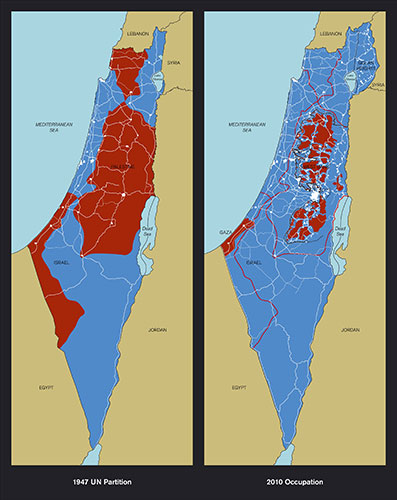
I want to write something simple, direct and therefore probably clumsy about what is going on when established art critics ignore and/or get snippy about a piece like Richard Hamilton‘s bold, brave and irreducible [this is the rub of course] work; Maps of Palestine.

Recognising the ethnic cleansing of Palestine and subsequent six decades of uniquely chronic entrenchment, overt war crimes slash crimes against humanity [oh those yada yada], ever more settlements and greater delusional sanctimony is forbidden in public discourse in Britain. Hence my ‘clumsiness’; you’ll need an open or well-informed mind to read on while I stumble through the ‘unsayable’.

It’s forbidden -or ‘unsayable’- partly because establishment Britain continues to offer cover as well as arms to the brave pre-pre-emptive killers of uniquely dispossessed, starved, besieged, picked off, randomly bombed, endlessly redisplaced and remassacred Palestinians, but also because it looked the other way for so long during a genocide much closer to home.

Maps of Palestine [2010] Richard Hamilton [w. thanks Eyal Weizman]

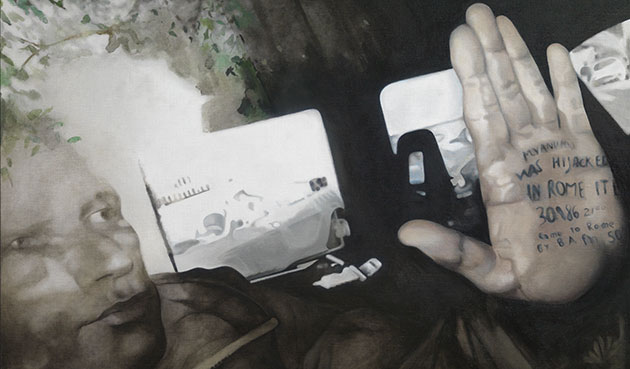
RH’s monumental maps are heart stopping; their allusions more shocking than anything that Koons and the Gang can muster. Art critical consensus mutters divertingly that it’s not really art is it? and if it is, it’s not really any good, is it? And, oh aren’t we a bit bored of this? They can’t say that about Unorthodox Rendition because it resonates visually with the equally ambiguous, uncannily similar, iconic image  of Jagger and Fraser, Swingeing London 67, which is secure in art history, but Maps is fair game, it’s easy…

Easy to ignore or disparage; bad politics and/or bad art. One of its actual characteristics is ‘simply’ political; the fact that it is a bald rendering of two maps of Palestine which make it evident that Palestinians have been cleansed from their homes and land and are now confined to tiny littering ‘camps’ [in Agamben’s sense, yes, but not exclusively here]. There is no disputing possible, no interpretation; this is simply the case. Which is why it’s not art, innit? That is; ideologically blinded by a perception that it’s ‘simply’ political, they can’t see anything else.

I want to say something about the way in which it is art in definitive ways and how its potent ambiguity as an object also makes it strikingly good, or anyway, lasting, art. It crystallises something unseen/unrecognised about the present which will resonate/fascinate in the future when ‘we’ will see better and with unerring perspective. In order to make that point carefully and probably clumsily I want to tell you another true story about Palestinian dispossession with covert establishment support.

The first time I actually met Mourid Barghouti, the great Palestinian poet and memoirist, was at a writer’s event in Norwich in 2005. These kinds of things; lots of writers from all over the place brought together for a ‘productive’ exchange, are often dire but this was not, I think. However, there was a round-table event that was profoundly degrading as well as terrifying in its way. A writer called AB Yehoshua was present, a man whose work is credibly literary, presumably the work of an agile albeit conservative mind. I don’t say this in the corruptingly ‘even-handed’ way that has so glossed Palestinian dispossession, but because I had positive expectations of him.

At one session, Mourid spoke very precisely about his own displacement and of place itself with a minimum of nomination, though of course when you tell the truth, even glancingly, it’s likely to hurt someone. He was calmly precise in mentioning some facts and asking open albeit suggestive questions. It was scrupulously exact and even respectfully polite; therefore very potent. For those who knew the background in depth it was clear that merely being allowed to stand there and say anything as a Palestinian was a mould-breaking, radical fact in itself.

[Actually, you can judge my memory  because Mourid’s paper Place as Time is online here and, in fact, pertains to what I’m trying to say here more broadly than I remembered]

When it came to Yehoshua, the tank-like figure that had barged and roared into the room morphed all-too easily into the Sharon-like Commander of US-supplied artillery. Spotting a Palestinian he opened fire with all he had to hand, no questions asked, perfect immunity assured and, however often this happens in actuality,  it was extremely shocking to witness. His blind rage, I mean in particular, and boy did he bluster and wow was it obvious that this is how it goes. He objected to something that all present knew to be the case; a recent example of Palestinian women being forced to give birth at illegal checkpoints erected on occupied territories held against International law [and more profound things] for decades.

The mere mention of this incontrovertible fact as an open question sent Yehoshua off into a reflex torrent of incoherent, self-defeating abuse in which he sought to say in essence; well if you weren’t intent on murdering lil’ ‘ol me I wouldn’t have to do it … if only you could grasp the relentless responsibility-taking that I do each and every day… but what would you know about that?

Somewhere in his rage he was complaining about the responsibility of the artist for what they say and/or do.  The obscenity of his violent outburst centred on his abuse of the most responsible of poets who had just given a very precise and elegant paper which exemplified the burden of artistic responsibility to perfection. Yehoshua meanwhile, abused his presence, his voices volume, the complicity of the British establishment, and raged on irresponsibly, not only refusing to take any responsibility for actual ongoing crimes, but abandoning any claim of artistic writerly responsibility in any and every conceivable way [and yes, I raise that to the highest, broadest of ethical categories].

His behaviour was obscene and cowardly; safe in the knowledge that he was squatting on a tank. It was terrifying because it revealed an entirely warped mindset, deeply entrenched in mass violence and practised impunity. At home his tank contains missiles. After missiles. After missiles. Here, his words were unleashed with the same intention; to kill the poet, the Palestinian, the other and any substantive sense of responsibility in art or elsewhere. What was shocking, indeed terrifying, was the knowledge that this small incident is played out endlessly, on a much greater scale, with blood and families and farmland and has been for more than six decades.

Almost more shocking was that the Chair made no sign of complaint, didn’t even notice anything unusual. It wasn’t that he felt awkward about how to rein in the verbal violence and lack of elemental human decency but that he was [I’m being kind] so immured to the established British discourse that he didn’t think there was anything even slightly odd about the outburst.

Art critics querying/ignoring Hamilton’s particular piece are not the Yehoshua in the story so much as the Chair; doing the work of casual complicity, blind to what is before them, ignorant of the artful potency of facts or the potency of facts used artfully.

The point about Hamilton’s piece of work is that it shows two separate realities -one potential and one actual- and makes no attempt to force meaning between them. No pointing, telling, explicating, merely the erection of two objects in space and time alongside each other; all relations open, a deep elliptical hole -more mysterious than a slathered over Anish Kapoor- of perfect ambiguity. As a work of art this is as close to the essence of what it is as you can get without it needing to be the most brilliant piece of art ever made or seen. To question this as art is to cancel art as a category.

Think of poetry and how it’s essence lies in Agamben’s reworked classicism; the enjambement of sound and meaning. Without the non identity of metre and sense text is not poetry at all; it only emerges as poetry in the very ellipsis formed [and is otherwise ‘mere’ prose] [See my Introduction to MB’s Midnight & Other Poems]. Similarly, it is the openness of the relationship between images [as well as viewer/s] here that makes it art.

One response to it is indeed simple, factual and unchallengeable; it is a map of ethnic cleansing yes, every bit as rigidly horrifying as aerial photographs of the infrastructure of death camps in the early mid-1940s [or that of settlements in the late 20th and early 21st century]. Infrastructure which, as here, war machines flew over without blinking, noticing, taking any responsibility for. ‘Camps’ which suit a purpose, a game ‘larger’ than the facts of chronic ethnic cleansing on the occupied ground.

A work of art, like a poem, that reminds me or exists only in this most elemental threshold zone is a blessing to receive. Before you tell me -or yourself- that this is not art or that it’s bad art, or that it’s ‘message’ is not very successfully conveyed, sit down and articulate to yourself what the relationship is between these two objects or images and then what the relationship is between them or that and you as a viewer. You might have to talk very precisely in general, and especially around how you distinguish the form that these two objects take from, say, two naked human figures stood in marble alongside each other. Why is that art? Why is that not bad art? Are you beginning to get it?

In fact this particular piece is not only a purified form of art, it is also fantastically humble and/or profoundly ethical art-making; an act undertaken for the other and otherness in its widest sense. I’m tempted to equate the refusing of it [the refusing to see or acknowledge it as art] with if not a crime but arguably an act against humanity.

I’m reminded of the sophistry that Emmanuel Levinas betrayed in an important and fascinating exchange in the immediate aftermath of the massacres at Sabra and Chatila, when a profound ethical response from a position of strength [the head of state responsible for those particular massacres said ‘No-one can teach us anything about morals’; an approach adhered to across the end of the century and beyond] might have helped [see; The Levinas Reader, ed. Sean Hand pp 289-297 Blackwell Oxford 1989]. If he misrepresented himself in the friendly context of the exchange, then it too was an ethical failure, surely?

Here is the contemporary face of ethical art making [with all its responsible innocence]. Today it is what it is, one day it will have extraordinary potency as a cultural object, a work of art. This image is only possible now; it is today writ large, in all its stark horror and misrecognition. Tomorrow it will seem inconceivable, impossible, absolutely mysterious. Tomorrow no-one will casually dismiss its status or its efficacy as art.

Tomorrow all those smugly complicit commentators will be eager defenders of the importance of memorialising the Nakba; the most committed to never again allowing humanity to descend to such depravity for so extended a period; the most insistent on the uniqueness of this horror, resistant of diluting comparisons to any other. But not until tomorrow.

Hamilton’s show contains a number of contemporary icons, stretching across the years and building potency in the present. With the new work, shockingly radical because so little else is, the show could almost just as well be called This is Tomorrow, but then that sounds strangely familiar…

richard hamilton at the serpentine one; we can be heroes…

Unorthodox Rendition [no date] Richard Hamilton

…just for one day or even one hour: go see Modern Moral Matters at the Serpentine 3 March-25 April 2010.

hero/ n. pl. heroes 1a a mythological or legendary figure often held to be of divine descent and to have great strength or ability b an illustrious warrior c a person, esp a man, admired for noble achievements and qualities [eg courage] 2a the principal male character in a literary or dramatic work b the central figure in an event or period.

heroic/ also heroical adj 1 of or suitable to heroes 2a showing or marked by courage and daring b grand, noble 3 of impressive size, power, or effect; large, powerful 4 of heroic verse synonyms see BRAVE.

heroism/ n heroic conduct qualities; esp extreme courage.

aisha khalid & imran qureshi @ corvi-mora to 6th march only

Pattern to Follow 2009 [DETAIL] Aisha Khalid

There are two very good reasons for me to return to the work of these exceptionally good artists. Firstly, it is the last week of their exhibition at Corvi-Mora. Secondly, the publication of extremely beautiful artist’s books by Raking Leaves is imminent. Exhibition and publications are best seen together. To do so you’ll have to hurry to the gallery this week [11-6 Tuesday-Saturday], then hold out until the publication date of 30th March.

AK is showing four large new paintings which mark a stylistic development on previous work, showcased in a retrospective at the surprisingly capacious Pumphouse Gallery in 2008. IQ is showing six small paintings from his Moderate Enlightenment series; complex portraits of his wife, self, gallerist and studio assistant. In truth it’s a frustratingly small selection, given that both artists deserve the attention that a gallery like the Serpentine can give their work individually. I’m counting the days until it catches up, but quietly dreading some kind of ‘Pakistani Byway’ confection instead.

AK’s new works render beautiful abysses into which swirl complexly patterned stars and squares of gold leaf. There is an all-consuming joy and abysmal dread in them, they are cosmological and catastrophic, thresholds and black holes. Her work has previously excelled with ambiguities of perceptual, personal and architectural space, explored realms of looking and being seen -with all the import both contain in our world of phenomenal/ogical ignorance- and return again and again to the [illustrated] book, often literally with exquisitely rendered lined pages from school books.

Along with a kind of undeclared Islamic minimalism in the work is a politics that has grown ever sharper. From problematising notions of the gaze, in which veiled women become what you want to see, her work has reached a stage where the pretty decorative ‘holes’ created in and by patterned, pulled together edges of fabrics, resemble bloody wounds in bodies with all-too real War on Terror referents. See the work made for the Queen’s Palace in the Bagh-e Babur, Kabul last year here and here.

These newest works are called Pattern to Follow and embody a distinct break. It is as if she can’t bear to look any more, has turned her eyes pleadingly towards an infinite universe or the embrace of god, her hands to the making of open questions. What has previously been indirect has turned full circle so that her most abstract even decorative works, I can’t help feeling, are most revealing of their actual context [WoT’s totalised global violence]. Elegant, visually compelling, geometrically abstract, non-declamatory, yet invested with passionate appeals to some form of justice beyond reach.

The Artist’s Wife & The Gallerist 2009 [DETAIL] Imran Qureshi

IQ’s works are from the ongoing series Moderate Enlightenment. Here he locates western representational portraits within familiarly patterned floral landscapes or more abstract spaces. Some of these highly refined images are then framed within a series of lined boxes which reframe and link with abstract shapes floating like blind spots from the sun to left or right.

These six make an unlikely introduction to his work and are not the strongest argument for its profound innovations. However, they are fascinating to linger with and contain many of the visual and other elements that characterise his wider work. There are hip young things standing in classical landscapes; one male figure stands at an uncomfortable angle to the viewer, casting an unusual shadow on the foreshortened wall behind him.

IQ’s self portrait is a head in profile within a tilting oval, surrounded by a wide mount of gold leaf. The head is naturalistic but doesn’t actually resemble the better looking artist. Every hair on his head seems to have been rendered with the miniaturists famously fine brushes and the flies swarming before him evoke the heated atmosphere in which the work was made. IQ’s trademark leaf-bouquets [reappropriated from Kangra paintings and made to symbolise love] loom beside his wife and gallerist -the latter’s woollen jumper displaying furry licks.

These paintings of IQ’s contain love ‘poems’, perhaps ghazals but in any case they represent a relatively benign world compared to his wife AK’s evident [though still always open, ambiguous, ambivalent] concern or anyway, the seriousness of her new work. There is a curious dialogue going on here and I like the workshop feel of them showing together, something explored to its limits with an earlier project called Kharkhana [a very fine catalogue is available here]. However, there’s no sense in which either ‘needs’ the other and as an exhibition it would compliment the work of both to show more work separately.

gil scott-heron; redone

I’m New Here is a great one; not just a new one but a riverrunning reconnection with the cool and conscious coming poet. Music stripped back to and built from words, no over-production of the moment [80s reggae sauce] but yet a 110 st 70s flavour. One which vies with all and everything before.

There’s the broken home of 125th and Lenox and ‘B-Movie’ ghetto get outs, a fine version of ‘I’ll Take Care of You’, which Mark Lanegan ‘owns’ as far as I’m concerned, even the title track’s perfectly tempered cover of a Bill Callahan song [if only it were ‘Dress Sexy at My Funeral’ -but heh?].

I don’t know about you, but I had all that right bang mid-horizon… Anyway, this is good but no longer hot news.

Then I noticed this:

A ‘secret’ collection of Angus [Fairhurst]’s very earliest work from the 1970s! I’d never realised it before, nor asked him about it… Peace go with you brother, from now on.

From South Africa to South Carolina here includes ‘Johannesburg’ on it -amongst  a range of gotta move on lovely days. For the first time I actually read the lyrics, heard often in the open-air and in tighter, warmer corners, Clapham Common [was it?!] to Portobello Road, being earnest, not being earnest:

I know that their strugglin’ over there
ain’t gonna free me,
but we all need to be strugglin’
if we’re gonna be free
Don’t you wanna be free?

One long day boycotts are laughed at, rejected, not noticed and seem peculiarly futile, the next day every one is suddenly on their weeping knees, wearing the t-shirt for a TV special.

‘Soft water vanquishes the mighty stone’; cup hands, pour!

mohan rana; more and less

Mohan Rana gave a reading recently as part of the Where Three Dreams Cross ‘season’ at the Whitechapel Gallery, London. He’s been working with The Poetry Translation Centre to render a selection from his several Hindi collections into English, most closely with Lucy Rosenstein and the poet Bernard O’Donoghue.

The latter read the poems in English after Mohan read in Hindi; his soft clear voice offering lilting repetitions and arhythmic developments alluringly. The English versions seemed pretty faithful to those tones; light, concrete, quotidian and yet also exploring loops of time, philosophical and metaphysical notions, specific Indian circularities and continuities as well as things irreducible and universal.

A Standard Shirt

by Mohan Rana

Between midday and nightfall
there comes a time
when the day’s noise and actions
are already done with,

just as now,
all desires quenched,
I am ready to sit down
on any chair.

A boy in a yellow shirt
has just passed by
and made me think
of a shirt of mine
in those old ordinary days.

So it was possible.
Yes, this life was possible.
And here I am, still wearing
a shirt just like that.

3.11.1988
From Jagah, Dwelling

I went partly because so little writing is ever translated from the various Indian languages into English that the UK seems stuck in a self-satisfied Slumdog circuit, fantastically incurious about the subcontinent beyond  visible/legible hoardings. It is the British disease; we like people from other places to come and tell us about -‘translate’/dilute- it in our terms and then leave it at that. Convenient, complacent, dumb.

So I walked the walk and was handsomely rewarded, because Mohan is a very fine poet who grew up in Old Delhi but has been a resident of Bath for 20 years. His poems conjure familiar images, times and places to me; habitual dawn and dusk walks through great cities, Delhi and Ahmedabad, old and new, very remote villages in the western extremities of India, riding through heavy monsoon rains beside the Narmada river. The poems are a portal to the interior world of boys with skateboards or green shirts in the gallery, for example, and to more universal places and times, real and imagined, within and beyond memory.

Larger elements shape the everyday in India with thousands of years of rehearsal and concretion. After Mohan’s reading there was a well-meaning question about influences, the answer to which is found throughout a written [spoken and sung] legacy that long predates northern Europe’s. In some puzzlement about where to begin, Mohan mentioned the Upanishads; a repository of songful teachings riddled with poetry and philosophical wisdom dating from some 2750 years ago.

The preceding Vedas are more like hymnals, of course, but I’m peculiarly fond of the Upanishads. I know, I can remember, how dauntingly monumental they seem before you trust yourself enough to read them like you would anything else. I’d recommend two very different versions in English, Juan Mascaro [whose Gita is my favourite version of that part of the Mahabarata, and whose Dhammapada is essential reading] made a peculiar but accessible thing out of them. Penguin UK published them first in 1965, a very slim and very Sixties version that is a perfectly good place to start.

However, Valerie Roebuck’s much fuller and exact translations which were first published by Penguin India in 2000 [2004 edition at 592 pages available here] is a far better, clearer and work-withable volume. Poetry and paradox [wordplay and pun, too, as she says] are elemental to these invaluable verses and I think help make them and subcontinental culture open and more transparent as a result. The verses or aural ‘teachings’ come with clear and authoritative explicatory notes too.

Against the context of AK Mehrotra obtaining a large number of votes in an apparently hopeless race for the Oxford professorship last year [which he ought to have got by default], I look forward to Mohan’s selection of poems being available to us all to buy and read tantalised/ingly on trains, under trees, to each other [in the rain]. Until then, you can visit his website, blog or this page of poems which includes those I’ve borrowed. There is a podcast of the reading here.

After Midnight

by Mohan Rana

I saw the stars far off –

as far as I from them:
in this moment I saw them –
in moments of the twinkling past.
In the boundless depths of darkness,
these hours
hunt the morning through the night.

And I can’t make up my mind:
am I living this life for the first time?
Or repeating it, forgetting as I live
the first moment of breath every time?

Does the fish too drink water?
Does the sun feel the heat?
Does the light see the dark?
Does the rain too get wet?
Do dreams ask questions about sleep as I do?

I walked a long, long way
and when I saw, I saw the stars close by.
Today it rained all day long and the words were washed away
from your face.

22.11.2009