on appetite and a mystic chef, george steiner essays, new statesman 1995

George Steiner August 2008

Or; If Kafka were Hindu…

Every now and then I wonder about George Steiner. Mostly it’s positive wondering but something bugs me about him and it’s not what seems to bug most people I know or read that have met him or committed their view of him to print. Much of the latter is merely a distaste for overt intellect, especially a passionate ‘continental’ mind as well as distrust of the whole dynamic of translation, literally and metaphorically.

There are pedagogic and vulgar ego issues when it comes to Steiner but let me say in brief that I dissociate myself from the cynical Brit approach to him. What continues to bug me is essentially what bugged me when I committed myself to print 15 years ago [in the New Statesman, see below]; I hate it that he won’t credit Kafka, Mozart, even little me with the capacity -effort, hours/years of silent striving and error, the beauty of the attempt- to invent.

Instead, it wasn’t Kafka or Mozart it was “god”. Who? you might say. Religious faith is one thing [later, in Errata, he described himself as a “messianic agnostic”, which is anticipated in what I wrote below], but to misrecognise the grand smallness of human effort, endeavour and appetite is wrong as well as pitiful.

Steiner is a man with a good brain and that brain has famous and all too real appetite but it strikes me therefore as worse that he closes it all down when he approaches a peak to indulge in ‘god’-whistling instead. Such vacuity is the opposite Continue reading “on appetite and a mystic chef, george steiner essays, new statesman 1995”

on silence or not, cage blake alÿs and on…

Rage Against the Machine’s “Killing…” made sense, mainly because it was such a great track back in the mid-90s, right? Cage Against the Machine, the attempt to block/buy the No. 1 slot for a recording of John Cage’s 4’33” -a rigorously orchestrated slice of atmospheric sound, often described as silence- was always a bit too clever and so a bit too dumb to work, no?

Kenneth Silverman’s recent biography of Cage, Begin Again, is a pretty straight celebratory record of an entirely remarkable life [and not published in the UK!]. Cage spans [subverts?] or strides [meanders?] the 20th Century in very particular ways, making work from beginning to end nearly and constantly mining the same seam of inventive attempts.

Always beginning again, afresh, anew -so the thesis runs. KS makes an epigram of Gertrude Stein’s gorgeous line from The Making of Americans; “Beginning was all of living with him, in a beginning he was always as big in his feeling as all the world around him.” The way in which this actualises is exemplary even while it creates doubt in me too -as the book goes on dutifully detailing yet another I Ching derived whatever!

4’33” was achieved using a deck of tarot cards, which even Cage said “seems idiotic” but he composed each movement by joining up randomised periods of silence with precise measures which totalled four minutes and thirty three seconds. The point, one made more precise by his subsequent visit of Ryoanji and fuller acquaintance with Zen, was that the ‘silence’ is a pregnant one, like the stone garden’s potent ‘blankness’.

Two thoughts; one links directly to the gorgeous version of Feist’s song, There’s a Limit to Your Love, that James Blake put out a month ago. As you know, the track is a departure from his flurry of promising EPs released this year alone, including CMYK and Klavierwerke, for foregrounding his voice against a piano track redolent of Nina Simone and an electronic bassquake. Apart from just enjoying it and its arguably rather more local newness I was struck by the ‘silence’ it contains. Or near silence, Continue reading “on silence or not, cage blake alÿs and on…”

on narrating gaza, this week in palestine [gaza three]

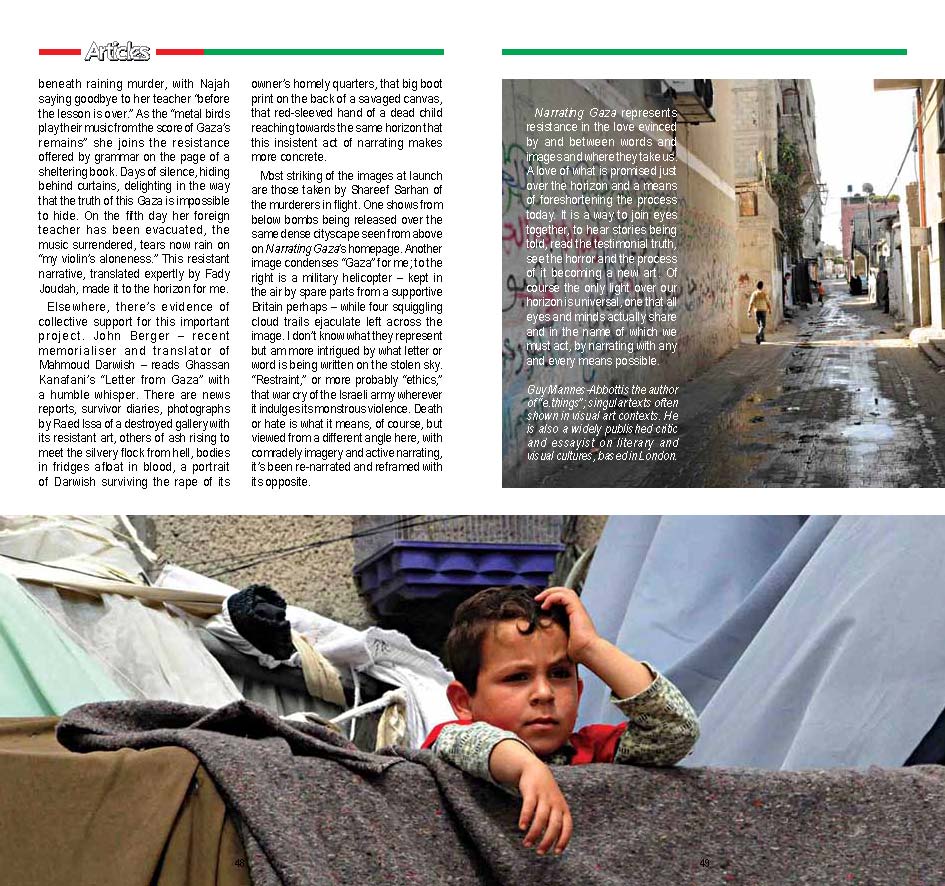
On Narrating Gaza…

By Guy Mannes-Abbott

“When it comes to sieges, precision is required to argue precedence. Besiegers appear all over the place and all over time. The besieged are always the same; rendered animal as time ceases and place becomes that time. The air is stifling, the end is collective yet still bespoke; you are abysmally alone. The military siege belongs to earlier ages but is too crudely effective to be left there, hence “Gaza.” Gaza, where one and a half million people – mostly refugees – have been besieged since June 2007 for their audacity to want to live in their own time and place. Where on 27 December 2008 their besiegers began celebrating the New Year early, culminating in the gift of white phosphorous shells for surviving school children. Witnessed by a never more seeing world…”

My text continues here.

This issue of the TWiP is here and can be downloaded as a pdf here.

Narrating Gaza [حكايات غزة], the new website dedicated to collecting and disseminating voices, images, words from Gaza and which occasioned this piece of mine, is here in Arabic and here in English.

NG can be contacted by potential contributors or the curious here: info [at] narratinggaza [dot] ps

in ramallah, running 2010 [excerpt], in ‘translated by’ 15.01.11 – 09.02.11


Translated By

15.01.2011 – 09.02.2011

Architectural Association Gallery

36 Bedford Square, London WC1B 3ES

Private view event on 14 January  6.30–8.30

Curators Charles Arsène-Henry and Shumon Basar

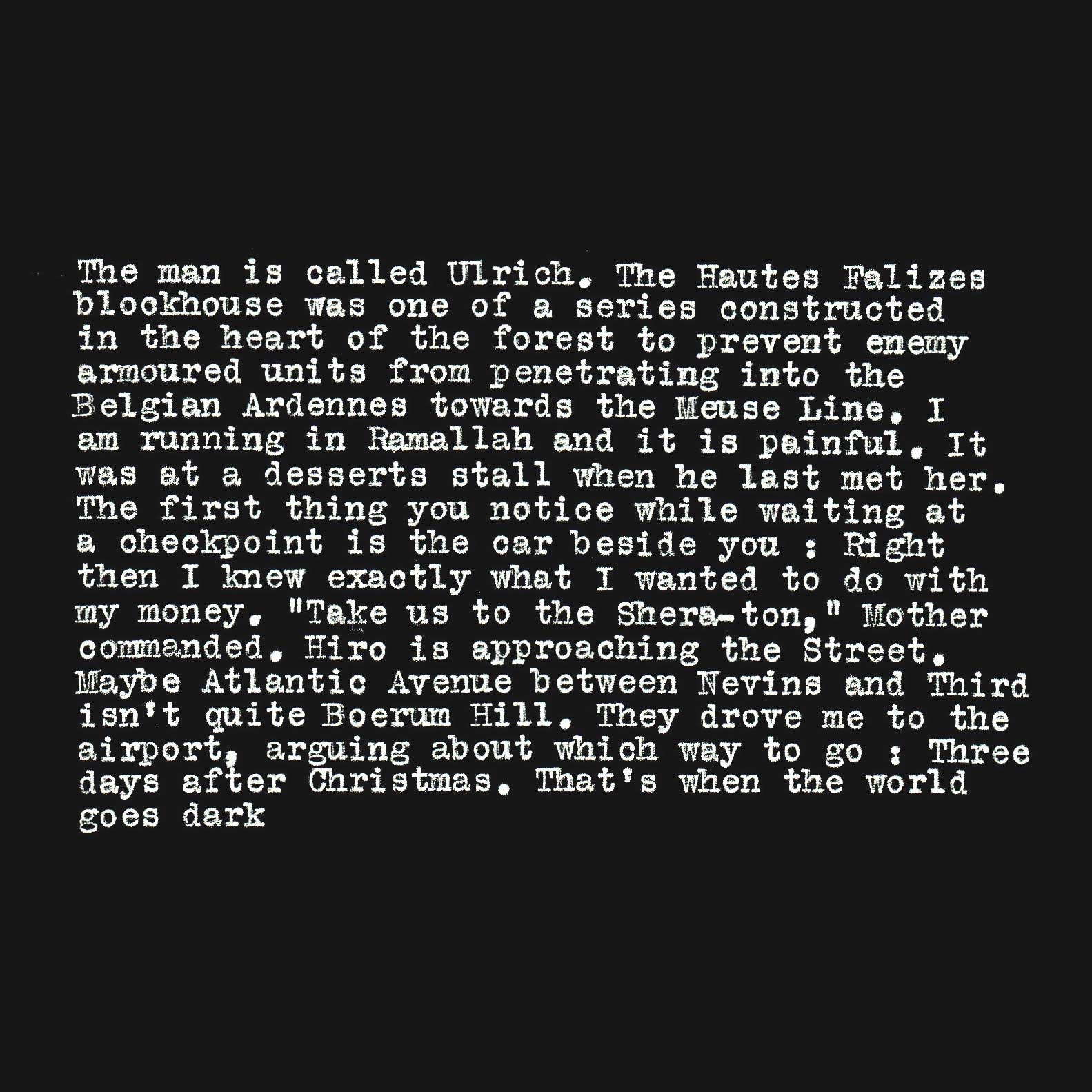
You’ve entered the room. It looks empty, silent. Vinyl text on the wall, like an album track-listing. Writers’ names instead of bands.
You’ve been given a black pamphlet and an electronic device connected to a pair of headphones.
You’ll put them on. Pick a number. Press play. You look for the same number on the walls. You find it. Next to it, an image. Beside there is a seat. You sit. On a beat up office chair dredged from a river. You listen. And you start travelling. You’re on Atlantic Avenue, between Nevins and Third. It’s Brooklyn. 1971.
The voice stops. You go for another track, another chair, a different place. Now on a little stool, you follow a six-year-old girl’s voice in your ears. You’re lost in the Sheraton Hotel. An Aztec spaceship in Doha’s desert.
It will last for 11 tracks. Through Tripoli, Brixton, Ramallah. Sofia, The Metaverse. Ardennes forest. A garden.
Until West Vancouver. Where the world is ending.

NB I have a text, a small excerpt from In Ramallah, Running 2010, in this show and publication in happy company… details to follow.

I’ll also update during January 2011 with news on the book itself as it progresses towards publication which is now scheduled for October 2011.

on admiring a writer like marguerite young

I’m posting this as a note; part a/ so that I have to come back with a part b/…

She flitted through my mind, old interviews and some of my own early wonderment [triggered by a 1989 issue of the often useful Review of Contemporary Fiction, in this case one dedicated to MY, Kathy Acker and Christine Brooke-Rose] at her and her work, never quite resolved [mostly available in Dalkey Archive Press].

If the words US, 20th C. and utopian spirit don’t work in your mind -cults don’t count- then you ought to get to know MY…

That edition of RCF’s interview is here; “…abandoned utopias. I would say my theme has always been paradise lost, always the lost cause, the lost leader, the lost utopia.”

For now then, a fan page of photographs [why not?!] here.

And a Paris Review interview from 1977 is here

New editions of her books available in the UK today start at 0.1p… and $0.40 in the US; an unequivocally good sign!

UPDATE 5 Sep 2022!

She understood that all truly ambitious literary projects will unsettle the reading public and are, by their very nature, doomed to teeter on the brink of failure. “I think anyone who tries anything real—think Proust or Dostoevsky—risks being an absolute fool,” she told Charles Ruas in 1977, and she took this pitfall as a kind of dare: “But if you’re mistaken, be terribly mistaken!” I believe that Young was not mistaken. With Miss MacIntosh she succeeded in executing what I consider to be an entirely original vision, though her intent has often been neglected and misunderstood.’

I am avoiding elaborating my own thoughts by shamelessly linking you to the Introduction by MEGHAN O’GIEBLYN to the new DAP edition of Miss Macintosh, My Darling that was recently published online by N+1:

LINK: More Is More

PDF: More Is More | Online Only | n+1 | Meghan O’Gieblyn Sorry, have removed the PDF immediately, since everyone is linking to it not the online page! Will post when the link gives up…?

godard’s film socialisme [two], patti smith’s on board…

Click on still to enlarge

I loved Godard’s new film on a first screening, with it’s refining of his late style towards pure -open/ambiguous- image [and away from the courts of filmedbook and bookedfilm]. I love it even more for having provoked grown boys to walk out of the screening at Cannes annoyed at the ‘lack’ of American cinematic narrative and even the abbreviated subtitles/quotes -so sure are they of the reliability of the English language in an age of peasprocess and warterror. It’s genuinely funny to observe what  upsets people like this when their expectations have sedimented so completely and they’re forced to face it.

In general I’m bored by cameo appearances in clever films by unlikely-but-credible people, yet Patti Smith [who is fallible too, btw] being on board for Godard’s mystifying journey was a real surprise and therefore to be celebrated. I look forward to Film Socialisme getting a good run at its London launch -ha! Godard says it’s his last film; not so funny.

Jonathan Romney is solid and true as ever in a short description for the LFF here. Or Gabe Klinger from Sight and Sound here.

The Village Voice ran a good piece here; “if you care about a living cinema, a cinema that asserts a blistering, confounding present even as it freights the past, then you should not be walking out on Jean-Luc Godard.”

More to come…

on the use of strawberries and [not even] carnations, gaza one

The Guardian’s Harriet Sherwood continues to report with clear-eyed vigour from Palestine. Her latest piece on Dashed Hopes, the collective updating of an earlier report by 21 International charities about the reality of life under siege in Gaza is profoundly shocking. It is mortifying. No, it’s revolting. Even so it might overstate the generosity of the state of Israel’s collective punishment, now in its fourth year.

HS writes that amongst other horrifying stats [“35% of Gaza’s farmland and 85% of maritime areas for fishing remains restricted by the Israeli ‘buffer zone’”], the only exports allowed by the Occupation are strawberries and carnations and those only to Europe. But perhaps not! The report, to which I urge you to link to [PRESS or for a pdf], states “except for the humanitarian activity of exporting a small amount of strawberries, not a single truck of exports has left Gaza since the ‘easing until now’.”

In any case, Gaza is populated almost entirely by refugees from the ethnic cleansing of the plains of Palestine in 1948. More than 60 years later, the offending party is able Continue reading “on the use of strawberries and [not even] carnations, gaza one”

on warbling from a to d [ari-up to devendra banhart]


Some deaths are bludgeoning and Ari-Up’s recent dying was one such. You can hear why just by listening to that great first album, Cut [1979], the maddened monkeying in heaven singularity of her manifested voice on ‘New Town’ etc. All those sounds went in to me so faithfully and long ago that really I don’t need to hear them from without as it were.

However, listening to ‘I Heard It Through the Grapevine’ today sounded more like tomorrow than yesterday; striking for one of the least digitally conceived songs ever [despite its very crisp production]…

I realised too that the warbling Continue reading “on warbling from a to d [ari-up to devendra banhart]”

on being uncagey about john, uk tour of cage exhibition into 2011

John Cage Ryoanji 17 February 1988 -pencil on Japanese handmade paper (ph Guy Mannes-Abbott)

Every Day is a Good Day [just say it, try… ]

This complete show of John Cage’s paintings and drawings is one that you need to go see, be with in real time and place. It’s not only that it doesn’t reproduce well [despite there being a very good catalogue with excellent reproductions newly photographed in it here updated link 2020] or that I’ve badly scanned one of my favourite delicate drawings done -in place of meditation- with more than one pencil around stones that were special to Cage [the allusion is to the famous dry stone garden at Ryoan-ji, Kyoto] but that until you’ve journeyed to stand before them, share their space you haven’t actually seen them.

I loved this exhibition of works for their affective simplicity -openness, lack of guile- and transforming leap from the disciplined procedures that generated them to their qualities as visual art. Continue reading “on being uncagey about john, uk tour of cage exhibition into 2011”

preface to epitaph, anne carson and nox in london nov 2010


Anne Carson Iceland 2009 [Photo Einar Falur Ingolfsson]

[Notes on Carson’s London reading of Nox, a couple of years after the last advertised event -in the wake of Decreation and also at SBC- was cancelled. They posted themselves raw a few days ago, here they are at least spell-checked…]

The first and easy thing to say about my obvious need to catch Anne Carson reading in London [Southbank Centre Poetry International Festival opening event Tuesday Nov 3] is that having gone only to see/hear the most significant poet in the English language actually read, perform, be in public the whole event was an instructive delight.

Carson was the last on of 6 poets, all of whom were worth seeing/hearing -if not memorable as such or as yet- but notable for me Continue reading “preface to epitaph, anne carson and nox in london nov 2010”