radwa ashour’s spectres, pamuk & pappe, november books of choice

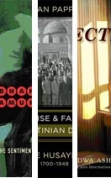
Radwa Ashour’s Spectres [Atyaaf أطياف] is now available in English [Trans. Barbara Romaine] from Arabia Books in the UK and makes essential reading. Alongwith new books from Orhan Pamuk [HUP] and Ilan Pappe [Saqi], Spectres is one of the November Book Choices at Babelmed [at my suggestion]. Hooray for Babelmed; yet another reason to check it out…

UPDATE 03.xii.2010 A very short review of Spectres, commissioned by The Independent, will appear soon…

paul auster, the sun never sets…

Paul Auster BOMB 1988 Photo © Susan Shacter

Auster has yet another new book due in November in the UK; Sunset Park here. I’ve not seen it yet and may yet write about it critically. Meanwhile, I’m reminded of an interview-based critical profile I did for The Independent around publication of the honourably slight Timbuktu which doubled with a screening of Lulu on the Bridge in London [ignored by distributors here despite or because of it being Auster’s directorial debut] as well as his contribution to Sophie Calle’s Double Game. Faber have just published the script again in a collection of his screenplays [Smoke, Blue in the Face, etc.], see here. Btw I don’t buy PA’s Beckett analogy below, not fully, and neither does Auster I’m sure.

Continue reading “paul auster, the sun never sets…”

on unlimited happiness, houellebecq interview paris review

I want to laugh at this photograph but can’t and don’t know why on either score…

Whoever decided to put this interview with Houellebecq -ostensibly around publication of La Carte et le Territoire [Flammarion 2010]- online in order to draw new/draw back old audiences to the let’s face it pretty wonderful Paris Review, must be pleased with themselves…

There are a few little things I quite like -though I’m just digesting some of MH’s thoughts here, no?

Continue reading “on unlimited happiness, houellebecq interview paris review”

doing a mahatma, james salter’s paris review interview online

The Art of Fiction No. 133 ManuscriptOh the lengths I indulged to get a copy of this a few years ago! I love an excuse to return to Salter and his Paris Review interview from the Summer 1993 issue [127 The Art of Fiction no. 133] being online now is enough for me. Here’s a tiny bit of it extracted from my rather long essay [Meeting James Salter];

“In the Paris Review interview of 1993 Salter said “I’ve never had a story in The New Yorker, everything has been rejected.” Of the 11 stories in Dusk -half of which are classics of the form- 9 were rejected by The New Yorker. He didn’t think to submit the other two.

Continue reading “doing a mahatma, james salter’s paris review interview online”

the model hip! hip! ben sonnenberg

Edward_Said_With_Ben_Sonnenberg

Edward Said and Ben Sonnenberg mid-80s [Photo Alexander Cockburn]

I liked and admired Ben Sonnenberg [though can’t claim to be one of his many close friends, nor did I ever meet him]; a man whose mind encompassed [and published] Anne Carson, James Salter and Edward Said, who understood what money was for, someone who left his beautiful and brilliant Grand Street magazine as the model of a good mind at work.

This piece by Alexander Cockburn [here link updated Apr 2020. PDF added below] is  a very warm remembrance of his friend Sonnenberg [1938-2010] following his memorial service in September, which I recommend to you:

“My favorite autobiographers in this century are Vladimir Nabokov, Theodor Adorno and Walter Benjamin.” A paragraph later he cited “my friend Edward Said,” whose savage essay “Michael Walzer’s ‘Exodus and Revolution’ – a Canaanite Reading” Ben had published in Grand Street in 1986.”


You might also dig up Salter’s account of Sonnenberg in Burning the Days; his much-admired aplomb in general and in the face of MS. Cockburn quotes Sonnenberg taking an elegant lance to The New Republic mag in 1989; oh for “puckish” courage of that kind today.

Continue reading “the model hip! hip! ben sonnenberg”

mourid barghouti, i was born there, i was born here

ولدت هناك، ولدت هنا   مريد البرغوثي

This is the front cover of my very own copy of Mourid Barghouti’s latest book I was Born There, I was Born Here, published by Riad El-Rayyes Books in May 2009. In Nablus you can pick up a cheaper pirate copy, but this one is the original with an embossed cover from Dar al Shourouk in Ramallah again.

I excuse my own excitement because I remember when Mourid first mentioned that he was writing this and have been waiting impatiently for its account of the period post 1996 when he was first able to return home -as recounted in the classic I Saw Ramallah- all the way up to and beyond the 2006 elections.

At this stage my Arabic makes reading this very slow work indeed, so I’m glad that Humphrey Davies has been appointed translator of the book and that the American University of Cairo Press [AUC] are scheduling the English translation for November 2011. I know that Bloomsbury were anticipating publishing the book in the UK and will update on both fronts when I receive confirmations. [Yes! Fall 2011 is the scheduled publication date for both.]

Meanwhile, there’s an intriguing 2000-word blog on the book, a first English language review including quite extensive translated passages, here, which I recommend to you.

Finally, given the familial dimension of this book -Mourid visits the alleys and suqs of al Qds/Jerusalem as well as the village of his young life Deir Ghassanah with son and poet Tamim- I can’t resist sharing my pleasure at seeing that novelist, academic, wife and mother Radwa Ashour has a newly translated novel, Spectres [Atyaf], forthcoming from Arabia Books [UK], who have a page here. I hope this will mark the beginning of good translations of all her works into English. In any case the arrival of this one is a major event.

Riad El-Rayyes Books [Arabic] website is here.

AUC Press is here.

Arabia Books here.

Nur Elmessiri article on Radwa’s Atyaf/Spectres in Al Ahram [1999] here.

My earlier post on Mourid’s Midnight and Other Poems, which Radwa translated -and for which I wrote the Introduction– is here.

‘Mourid and Tamim Barghouti with Ahdaf Soueif’ event at the Southbank Centre London, Saturday November 6th is here.

on not meeting edward said, who was right then and is right now

I enjoy unlikeliness and it seemed unlikely to me that Candia McWilliam would find herself in Edward Said’s memoir of his early life; Out of Place: A Memoir [Granta 1999]. That she does so in her own memoir [What to Look for in Winter: A Memoir in Blindness Cape 2010/Vintage 2011] is one of many endearing things about it and its author. Also a high recommendation for Said and his own memoir.

I spent a number of mornings in June this year running past one end of Edward Sa’id Street in Ramallah, actualising the way he and his work feature near the beginning of my adult life and have been returned to repeatedly ever since. I’m posting an old review I did for The Independent of his collection of pieces The End of the Peace Process: Oslo and after [Granta 1999 -out of print/PenguinRandomHouseUS 2001 -linked] [BELOW]. Read almost anything of Said’s [especially on the question of Palestine] and the absence of a voice like his today makes you weep.

Continue reading “on not meeting edward said, who was right then and is right now”

kanafani’s rijal fii al shams/men in the sun, a celebration

I’m just celebrating my acquisition of the book in Arabic from the huge and richly stocked Dar al Shourouk -which is nicely complemented by the small and richly stocked al Jameat- in Ramallah. Since posting on Kanafani I want y’all to know that search engines connect someone to that page every day, which suggests a significant market for the book.

I’m pleased to see that Arabia Books have just re-issued Emile Habiby’s The Secret Life of Saeed the Pessoptimist and have a page on it here. (Updated Mar 2018) With the warmest respect to Kanafani’s publisher in Colorado [in English] and in Nicosia [Arabic] I do wish there were a UK edition…

Meanwhile Men in the Sun is available from UK distributors here.

Dar al Shourouk’s Arabic website is here and they can be contacted at shorokpr [at] palnet [dot] com

Al Jameat can be contacted at al-jameat [at] maktoob [dot] com

Russell Hoban lost and found, for the record [like it’s 19_99].

With another new novel due from Russell Hoban this Winter [Angelica Lost and Found, Bloomsbury], I’m re-archiving a profile/interview/critical piece I wrote for The Independent near the beginning of his admirably sustained resurgence -if I can put it like that.

So much earnest nonsense is regurgitated in the British press about ‘lateness’ in the writing of fiction -usually from the chin of Martin Amis- that I enjoy the way that Hoban continues to take his chances, give his best shot, make more writerly attempts. I admire him as a writer as such, rather more than for his writing sentence-by-sentence, which I hope I articulate with more precision below.

Some of my favourite works of fiction -let’s just instance Bouvard and Pecuchet– were written not only ‘late’ but too late -in that they’re not ‘finished’. Actually, I shouldn’t blame Amis [whose Success, Money and Experience will last] for having his thoughts/neuroses on the subject, but those who have reported boyish bar-talk so solemnly throughout my entire adult life!

So here is the Hoban rescued from The Independent’s patchy site. One thing; mention of a blue plaque [in a sentence with a cut and now edited-back-in second half for clarity] was a joke! Right? Obviously. Or it would be obvious to anyone that knows him or his work, or indeed me and mine. In the back of my mind were the ironies of memorialising Edgar Allan Poe’s short time in London -The Man of the Crowd, all that.

His British publisher’s page is here and a well-stocked ‘reference page’ is here.

A first review of Angelica Lost and Found is here.

Continue reading “Russell Hoban lost and found, for the record [like it’s 19_99].”

robert walser and the microtexts; coming soon

The Microscripts by Robert Walser May 2010

“Robert Walser wrote many of his manuscripts in a highly enigmatic, shrunken-down form. These narrow strips of paper (many of them written during his hospitalization in the Waldau sanatorium) covered with tiny ant-like markings only a millimeter or two high, came to light only after the author’s death in 1956. At first considered a secret code, the microscripts were eventually discovered to be a radically miniaturized form of a German script: a whole story could fit on the back of a business card. Selected from the six-volume German transcriptions from the original microscripts, these 25 short pieces are gathered in this gorgeously illustrated co-publication with the Christine Burgin Gallery. each microscript is reproduced in full color in its original form: the detached cover of a trashy crime novel, a disappointing letter, a receipt of payment.”

Taken from the very great New Directions’ site here.

One microtext, The Prodigal Son, is online here.

These texts have been translated by Susan Bernofsky, who is also still working on her Life of RW…

Otherwise, with so much now available of Walser’s it might be easy to have overlooked Speaking to the Rose Writings 1912-32, published by Bison Books [here]. Most of these 50 ‘microtexts’ were previously unpublished and have been translated by Christopher Middleton.

Here is JM Coetzee on two of Walser’s novels in the NYRB 2000.

Here is Benjamin Kunkel’s recent New Yorker profile 2007.

Here is a very dedicated and newsy site.

More, later, hopefully…