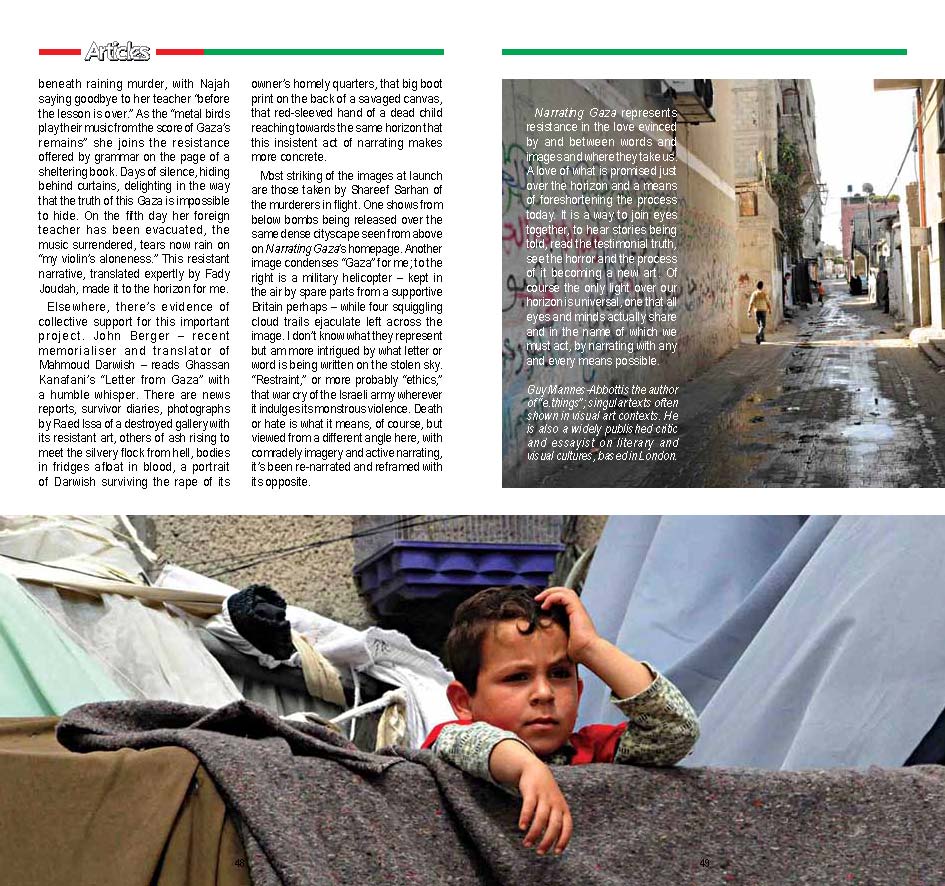
on narrating gaza, this week in palestine [gaza three]

On Narrating Gaza…

By Guy Mannes-Abbott

“When it comes to sieges, precision is required to argue precedence. Besiegers appear all over the place and all over time. The besieged are always the same; rendered animal as time ceases and place becomes that time. The air is stifling, the end is collective yet still bespoke; you are abysmally alone. The military siege belongs to earlier ages but is too crudely effective to be left there, hence “Gaza.” Gaza, where one and a half million people – mostly refugees – have been besieged since June 2007 for their audacity to want to live in their own time and place. Where on 27 December 2008 their besiegers began celebrating the New Year early, culminating in the gift of white phosphorous shells for surviving school children. Witnessed by a never more seeing world…”

My text continues here.

This issue of the TWiP is here and can be downloaded as a pdf here.

Narrating Gaza [حكايات غزة], the new website dedicated to collecting and disseminating voices, images, words from Gaza and which occasioned this piece of mine, is here in Arabic and here in English.

NG can be contacted by potential contributors or the curious here: info [at] narratinggaza [dot] ps
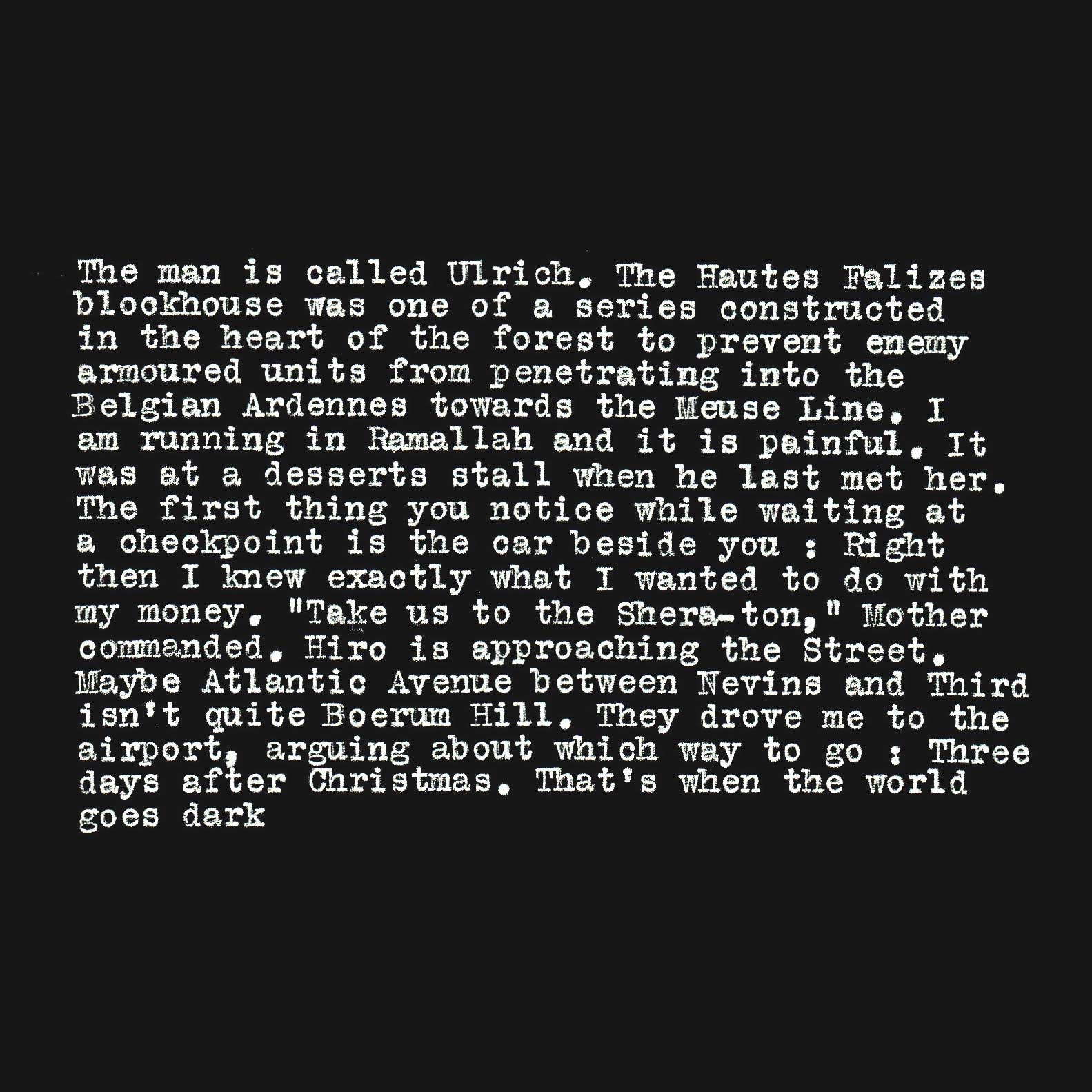
in ramallah, running 2010 [excerpt], in ‘translated by’ 15.01.11 – 09.02.11


Translated By

15.01.2011 – 09.02.2011

Architectural Association Gallery

36 Bedford Square, London WC1B 3ES

Private view event on 14 January  6.30–8.30

Curators Charles Arsène-Henry and Shumon Basar

You’ve entered the room. It looks empty, silent. Vinyl text on the wall, like an album track-listing. Writers’ names instead of bands.
You’ve been given a black pamphlet and an electronic device connected to a pair of headphones.
You’ll put them on. Pick a number. Press play. You look for the same number on the walls. You find it. Next to it, an image. Beside there is a seat. You sit. On a beat up office chair dredged from a river. You listen. And you start travelling. You’re on Atlantic Avenue, between Nevins and Third. It’s Brooklyn. 1971.
The voice stops. You go for another track, another chair, a different place. Now on a little stool, you follow a six-year-old girl’s voice in your ears. You’re lost in the Sheraton Hotel. An Aztec spaceship in Doha’s desert.
It will last for 11 tracks. Through Tripoli, Brixton, Ramallah. Sofia, The Metaverse. Ardennes forest. A garden.
Until West Vancouver. Where the world is ending.

NB I have a text, a small excerpt from In Ramallah, Running 2010, in this show and publication in happy company… details to follow.

I’ll also update during January 2011 with news on the book itself as it progresses towards publication which is now scheduled for October 2011.

on the use of strawberries and [not even] carnations, gaza one

The Guardian’s Harriet Sherwood continues to report with clear-eyed vigour from Palestine. Her latest piece on Dashed Hopes, the collective updating of an earlier report by 21 International charities about the reality of life under siege in Gaza is profoundly shocking. It is mortifying. No, it’s revolting. Even so it might overstate the generosity of the state of Israel’s collective punishment, now in its fourth year.

HS writes that amongst other horrifying stats [“35% of Gaza’s farmland and 85% of maritime areas for fishing remains restricted by the Israeli ‘buffer zone’”], the only exports allowed by the Occupation are strawberries and carnations and those only to Europe. But perhaps not! The report, to which I urge you to link to [PRESS or for a pdf], states “except for the humanitarian activity of exporting a small amount of strawberries, not a single truck of exports has left Gaza since the ‘easing until now’.”

In any case, Gaza is populated almost entirely by refugees from the ethnic cleansing of the plains of Palestine in 1948. More than 60 years later, the offending party is able Continue reading “on the use of strawberries and [not even] carnations, gaza one”

preface to epitaph, anne carson and nox in london nov 2010


Anne Carson Iceland 2009 [Photo Einar Falur Ingolfsson]

[Notes on Carson’s London reading of Nox, a couple of years after the last advertised event -in the wake of Decreation and also at SBC- was cancelled. They posted themselves raw a few days ago, here they are at least spell-checked…]

The first and easy thing to say about my obvious need to catch Anne Carson reading in London [Southbank Centre Poetry International Festival opening event Tuesday Nov 3] is that having gone only to see/hear the most significant poet in the English language actually read, perform, be in public the whole event was an instructive delight.

Carson was the last on of 6 poets, all of whom were worth seeing/hearing -if not memorable as such or as yet- but notable for me Continue reading “preface to epitaph, anne carson and nox in london nov 2010”

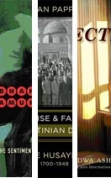
radwa ashour’s spectres, pamuk & pappe, november books of choice

Radwa Ashour’s Spectres [Atyaaf أطياف] is now available in English [Trans. Barbara Romaine] from Arabia Books in the UK and makes essential reading. Alongwith new books from Orhan Pamuk [HUP] and Ilan Pappe [Saqi], Spectres is one of the November Book Choices at Babelmed [at my suggestion]. Hooray for Babelmed; yet another reason to check it out…

UPDATE 03.xii.2010 A very short review of Spectres, commissioned by The Independent, will appear soon…

the model hip! hip! ben sonnenberg

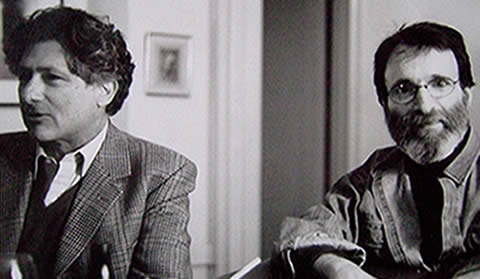
Edward_Said_With_Ben_Sonnenberg

Edward Said and Ben Sonnenberg mid-80s [Photo Alexander Cockburn]

I liked and admired Ben Sonnenberg [though can’t claim to be one of his many close friends, nor did I ever meet him]; a man whose mind encompassed [and published] Anne Carson, James Salter and Edward Said, who understood what money was for, someone who left his beautiful and brilliant Grand Street magazine as the model of a good mind at work.

This piece by Alexander Cockburn [here link updated Apr 2020. PDF added below] is  a very warm remembrance of his friend Sonnenberg [1938-2010] following his memorial service in September, which I recommend to you:

“My favorite autobiographers in this century are Vladimir Nabokov, Theodor Adorno and Walter Benjamin.” A paragraph later he cited “my friend Edward Said,” whose savage essay “Michael Walzer’s ‘Exodus and Revolution’ – a Canaanite Reading” Ben had published in Grand Street in 1986.”


You might also dig up Salter’s account of Sonnenberg in Burning the Days; his much-admired aplomb in general and in the face of MS. Cockburn quotes Sonnenberg taking an elegant lance to The New Republic mag in 1989; oh for “puckish” courage of that kind today.

Continue reading “the model hip! hip! ben sonnenberg”

settlements app, the actuality is significantly worse

The Guardian reports [here] on the launch by American Friends of Peace of an app -Facts on the Ground- designed to keep the shameless growth of illegal settlements to hand. The idea is that, just as with previous historical examples of massive or sustained crimes against humanity, you can’t say you didn’t know. [Re; imminent end of temporary freeze, expect another shorter one with various exclusions -and renewed slaughter somewhere or other- by the masters of exceptionalism. Or out and out resumption of same. They won’t actually stop, they will have to be stopped, actually.]

iPhone Screenshot 1

So it’s very welcome; you can check the number of illegal settlers of a hyper-nationalist or -religious persuasion and how much of the settlement is classified as “private Palestinian land” just as easily as you can check how many Boris Bikes are at each stop. My only complaint is that even with this to hand the actuality is underplayed. How do I know? Because I’ve walked around these very settlements, onto overlooking hills and photographed them only this summer. I’ve witnessed the actuality and know the truth. Just as every Palestinian imprisoned in the otherwise gorgeous hills knows -something you might ponder.

Continue reading “settlements app, the actuality is significantly worse”

the great game, raouf haj yihya in liverpool

If you can’t get to Liverpool for the current Biennial [18th September-28th November 2010], and especially to the Future Movements Jerusalem section of the City States show at the Contemporary Urban Centre [curated by Samar Martha], then at least you can sample one of the art works here [Press image to play, it takes a few seconds to load].

Continue reading “the great game, raouf haj yihya in liverpool”

mourid barghouti, i was born there, i was born here

ولدت هناك، ولدت هنا   مريد البرغوثي

This is the front cover of my very own copy of Mourid Barghouti’s latest book I was Born There, I was Born Here, published by Riad El-Rayyes Books in May 2009. In Nablus you can pick up a cheaper pirate copy, but this one is the original with an embossed cover from Dar al Shourouk in Ramallah again.

I excuse my own excitement because I remember when Mourid first mentioned that he was writing this and have been waiting impatiently for its account of the period post 1996 when he was first able to return home -as recounted in the classic I Saw Ramallah- all the way up to and beyond the 2006 elections.

At this stage my Arabic makes reading this very slow work indeed, so I’m glad that Humphrey Davies has been appointed translator of the book and that the American University of Cairo Press [AUC] are scheduling the English translation for November 2011. I know that Bloomsbury were anticipating publishing the book in the UK and will update on both fronts when I receive confirmations. [Yes! Fall 2011 is the scheduled publication date for both.]

Meanwhile, there’s an intriguing 2000-word blog on the book, a first English language review including quite extensive translated passages, here, which I recommend to you.

Finally, given the familial dimension of this book -Mourid visits the alleys and suqs of al Qds/Jerusalem as well as the village of his young life Deir Ghassanah with son and poet Tamim- I can’t resist sharing my pleasure at seeing that novelist, academic, wife and mother Radwa Ashour has a newly translated novel, Spectres [Atyaf], forthcoming from Arabia Books [UK], who have a page here. I hope this will mark the beginning of good translations of all her works into English. In any case the arrival of this one is a major event.

Riad El-Rayyes Books [Arabic] website is here.

AUC Press is here.

Arabia Books here.

Nur Elmessiri article on Radwa’s Atyaf/Spectres in Al Ahram [1999] here.

My earlier post on Mourid’s Midnight and Other Poems, which Radwa translated -and for which I wrote the Introduction– is here.

‘Mourid and Tamim Barghouti with Ahdaf Soueif’ event at the Southbank Centre London, Saturday November 6th is here.

on not meeting edward said, who was right then and is right now

I enjoy unlikeliness and it seemed unlikely to me that Candia McWilliam would find herself in Edward Said’s memoir of his early life; Out of Place: A Memoir [Granta 1999]. That she does so in her own memoir [What to Look for in Winter: A Memoir in Blindness Cape 2010/Vintage 2011] is one of many endearing things about it and its author. Also a high recommendation for Said and his own memoir.

I spent a number of mornings in June this year running past one end of Edward Sa’id Street in Ramallah, actualising the way he and his work feature near the beginning of my adult life and have been returned to repeatedly ever since. I’m posting an old review I did for The Independent of his collection of pieces The End of the Peace Process: Oslo and after [Granta 1999 -out of print/PenguinRandomHouseUS 2001 -linked] [BELOW]. Read almost anything of Said’s [especially on the question of Palestine] and the absence of a voice like his today makes you weep.

Continue reading “on not meeting edward said, who was right then and is right now”