A previous post on Mohamedi referred to my catalogue text from 2001. Now I’m posting my short review of her recent retrospective exhibition as it appeared in the UK. I was pleased and proud to write something on a show that went almost unnoticed -and was certainly not engaged with- in the UK [again], but there’s much more to be written about her work and its contexts.
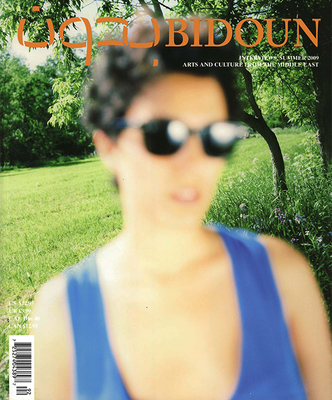
For now, here are scans of the pages in Bidoun [below; click to enlarge]. Let me repeat that it’s essential wherever you are in the world to see the work itself -to stand in front of the drawings in particular- whenever the opportunity arises. Until you do you will have missed an important 20th Century artist and maker of our new world.
I’ll return to Nasreen Mohamedi at greater, speculative and more definitive length in the future…
I finally made it back to see Cerith’s show at White Cube’s Mason’s Yard which is, I want to emphasise, just off Piccadilly in central London. The show closes on May 22 and I urge you to drop by to catch a stunning and substantial installation of recent works which makes the space live so well that it claims possession of it.
My hopes were high for this show but I had to rush through an opening that was as busy as you might expect to be somewhere else. As a result I didn’t quite trust my impression that CWE had drawn all the currents in his work together into something quite so winningly complete. That is -at its most elemental- influence and intellect, taste and fancy all deliver something complex here that is coherent only as visual art. It’s clarified resonance would justify permanent -or DIA-style- installation in the site.
A peculiarly all over the place month made returning impossible, but the work lingered and I had to see it again especially if I were to scribble something here…
I first met Slavoj Zizek in Bloomsbury in 1998 to conduct a relaxedly spontaneous, short but full-blooded interview in what I was to discover is the authentic Zizekian mode. I knew his work, had seen him speak, admired his reworking of various Idealists more than the brilliant-but-familiar bug-eyed film theorist and, armed only with a dodgy autobiographical preface, wondered about who he was. I’ve just found the 22,000 word transcript of that first meeting. Afterwards we wandered through Georgian Squares in the University quarter and he graciously accompanied me as far as possible whilst exchanging gossip eagerly, before cutting back to a meeting.
That initial meeting was something of a rehearsal for a plan for me to go to Ljubljana -before easyjet!- to spend a week doing a series of focused interviews. Whilst in that memorably lively city, Zizek would introduce me to key figures from Slovenia’s recent underground; activists, politicos, Laibach, Mladen Dolar and the Lacanian gang, etc. Those sessions produced 14 hours of tape containing dense and agile theorising, but the generous backers of my trip bottled out of publishing the resulting coup [editor had been ‘moved on’, their ‘reliable’ stand-in quoted Bertrand Russell approvingly, as in ‘the only thing I know about Hegel is what Bertrand Russell said…” Weep] -as was always an open possibility. A possibility that had liberated me to do it fully and properly.
Thereafter, there were some telephone conversations and emails and Zizek sent me his “Kosovo 4.99” piece on the double bind of supporting exceptionally belated foreign intervention to stop Serbian fascism’s campaign of ethnic cleansing; Against the Double Blackmail. A phrase from a clarifying phone call I made to him went in to the first substantial piece published on him in a UK journal [below] around publication of The Ticklish Subject and The Zizek Reader in 1999.
The so-called “Kosovo 4.99” text Zizek sent me was then staged as an exhibition of wall-texts [with a pirate radio installation by Gregory Green] at Cubitt Gallery and as an insert in the pages of Third Text magazine. I came across the original email to me with that ‘lost’ interview transcript. At the time I asked Cubitt to remove the note from SZ with thanks to me from their website because I was embarrassed! Somehow, they took the whole text down instead. After all this time, I’m linking to a pdf of it below with no shame at all.
“Robert Walser wrote many of his manuscripts in a highly enigmatic, shrunken-down form. These narrow strips of paper (many of them written during his hospitalization in the Waldau sanatorium) covered with tiny ant-like markings only a millimeter or two high, came to light only after the author’s death in 1956. At first considered a secret code, the microscripts were eventually discovered to be a radically miniaturized form of a German script: a whole story could fit on the back of a business card. Selected from the six-volume German transcriptions from the original microscripts, these 25 short pieces are gathered in this gorgeously illustrated co-publication with the Christine Burgin Gallery. each microscript is reproduced in full color in its original form: the detached cover of a trashy crime novel, a disappointing letter, a receipt of payment.”
Taken from the very great New Directions’ site here.
These texts have been translated by Susan Bernofsky, who is also still working on her Life of RW…
Otherwise, with so much now available of Walser’s it might be easy to have overlooked Speaking to the Rose Writings 1912-32, published by Bison Books [here]. Most of these 50 ‘microtexts’ were previously unpublished and have been translated by Christopher Middleton.
Here is JM Coetzee on two of Walser’s novels in the NYRB 2000.
Here is Benjamin Kunkel’s recent New Yorker profile 2007.
I just want to flag up this exhibition curated around Morton Feldman which I haven’t and won’t see [partly because I’m away doing a Residency myself during June] with its intriguing catalogue which I’ve also not seen yet.
Vertical Thoughts; Morton Feldman and the Visual Arts looks like a full-blooded collection of visual materials linked to Feldman and any focus on Feldman is welcome. I wonder why it isn’t travelling to other museums of modern art; Tate Modern for instance?
Kevin Volans has a piece in the catalogue [and a slightly out of date website here]. I caught his 60th birthday performance a few months ago [Wigmore Hall, Nov 09] which was excellent. Afterwards he described how he’s increasingly reliant as a composer and performer on visual art’s receptivity and commissioning resources.
Music-wise, there’s still a performance to come of Rothko’s Chapel and Words and Music by Samuel Beckett on 30th May by the Crash Ensemble here.
Tony Judt’s Ill Fares the Land is the kind of passionate polemic that Britain no longer does. It’s objective is to define the barbaric state we’re in in such a way as to generate articulate responses that will change it. The tool is an accessible discursiveness aimed explicitly at youthful agents of change.
Urgency is required because, as Judt says in his opening line, “Something is profoundly wrong with the way we live today.” Urgency also reflects the author’s suffering from the terminal effects of a rare form of motor neuron disease. That this book arrived so soon after his heroic October 09 lecture at the Remarque Institute [see link below], is to the significant credit of all parties.
Judt’s introductory mapping continues like this; “For thirty years we have made a virtue out of the pursuit of material self-interest: indeed, this very pursuit now constitutes whatever remains of our sense of collective purpose”. He concludes his book thus; “if we think we know what is wrong, we must act upon that knowledge.” But “our disability is discursive”; to act requires words; the articulation of a common purpose, including a recovered ability to preach what social democracy at its extant best practises.
Judt argues that the last 30 years have been aberrant and corrupting and he is largely right. He argues that the years between 1989 and 2009 were wasted on locusts and he is not entirely wrong. His polemic is broader than this though; it’s the loss of the 20th Century -with its significant if sporadic advances in civility- that he laments. More positively, he goes on to argue that what he calls the ‘left’ must celebrate and defend its achievements, though I don’t think he has Hardt/Negri in mind.
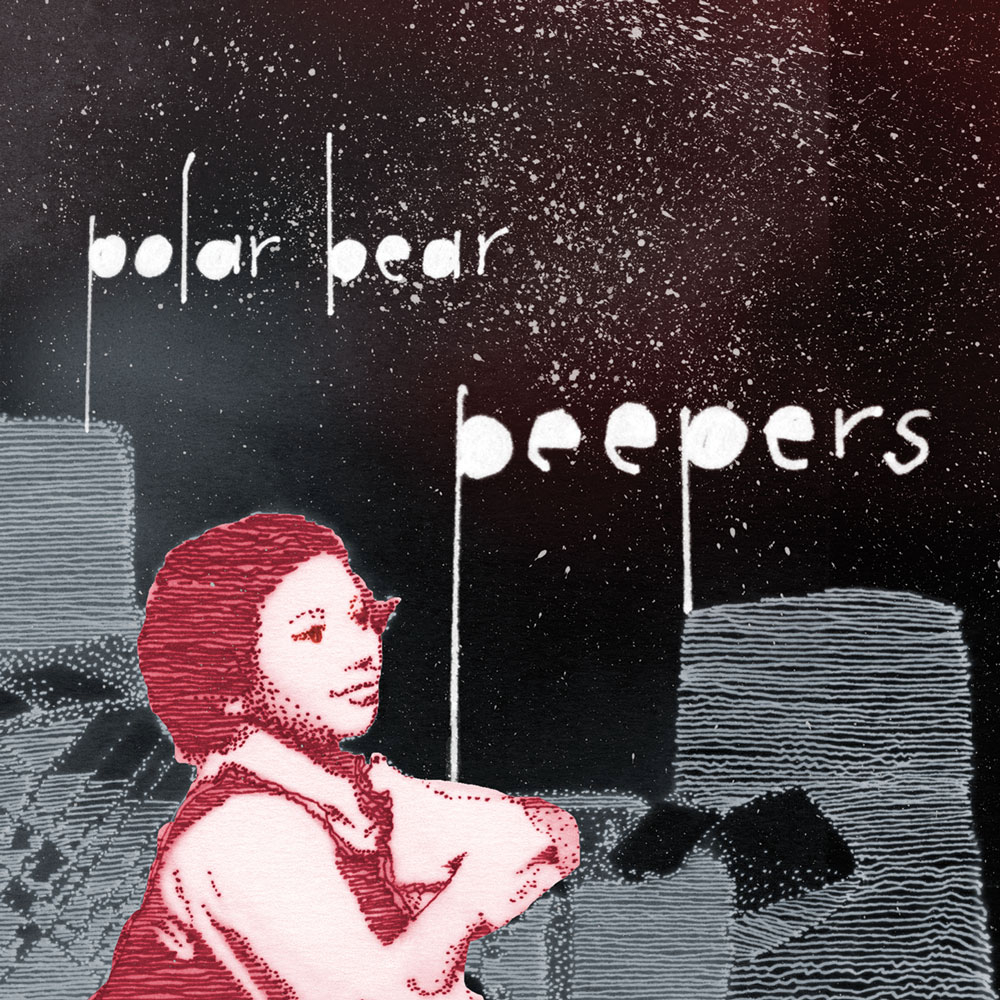
Polar Bear gave a free concert in the QEH foyer as part of the Ether Festival on Friday 23 April and it was … “following”. They have their new cd Peepers out and are on tour until October to celebrate it and you can join in through their website here.
I’d never caught them live before and they were brilliant; tight as performers, expansive as musicians, maxed-up jazz-men especially with their unlikely innovations involving a guitar and box of electronic tricks. Jumping, infectious, toughened up by indigenous anarchism and … “following.” Peepers captures all the peculiar liveliness of the band live very well.
If you know Polar Bear already then you don’t need me to say anything, if you don’t then I have a feeling there’s nothing I can say that will get you over the levée. Except this; trust me!
I took along someone who for reason of age alone is new to jazz -certainly live- and once the buzz of a packed-in audience faded a kind of bodily confusion set in which took a track or two to change and for my little friend to find his own way in. A particular unusually compressed sound made and repeated by one of the sax players triggered the change and then my friend quickly engaged the jazz of it; the expansive wrapping and precise rolling of Seb Rochford’s drum playing, the brittle electronic sounds of Leafcutter John and his skanking guitar, the biting double bass of Tom Herbert and the explosive tenor sax playing of Pete Wareham [and stand-in? Shabaka Hutchings too].
There was a nice moment when Seb Rochford introduced the track ‘want to believe everything’ saying “when I wrote it I was thinking about keeping faith in people and with, like all the bad things happening in the world, people are always telling us to just keep your faith … so that’s what I’m finding, you know, just to try to keep that. So that’s what this tune’s about” and as he did so the sun fell into the window behind him in such a way as to backlight his architecturally frizzed hair from behind. It didn’t seem inappropriate or anything less than just jazz.
There are lots of ways of trying to say this but Polar Bear are uniquely of the now. They’re doing their own thing on a new label, are as good as it gets and gracious with it. Don’t catch up with them later/one day, be sure to catch them now.
Here’s a clip from Later … in which they perform the title track from Peepers. As good and faithful as this is, it looks and sounds as if they’ve been confined to a small box…
Wondering about Kanafani’s book today, I checked yet again to see if it’s in print at all and specifically in the UK. (Updated links Mar2018)
I was wrong to describe it [earlier] as out of print, since it’s available in the US from Lynne Rienner Publishers here [Updated Dec 2023]. LRP do have a London office too; the two Kanafani books I link to below are available from their UK distributors here [Updated Dec 2023]. [I’m correcting my original post which criticised the lack of an equivalent British publisher. Does it matter in our cowardly new world? I think it does actually, yes.]
Men in the Sun [Rijal fi-al-shams [1962/3] was one of the first books by a Palestinian writer I read; entry point, beginning. I admired it first time up but wasn’t able to get a real hold on it or place it in a wider [Palestinian] literature.
I expect that this is a common experience in general, although if Mourid Barghouti‘s classic memoir I Saw Ramallah is a similar entry point for many today -as anecdotal experience suggests- the effect will also differ. MB’s book is more self-contained in this sense, its brilliant opening chapter The Bridge carries the voice of these men in the sun [amongst many others and much else] back home. Readers familiar with both will, I hope, forgive the purposive crudity of such an analogy.
I re-read Men in the Sun recently in a slim and very simply produced Heinemann/Three Continents Press edition [it first arrived in English in American University of Cairo Press, AUC, whose excellent back- and ongoing list is emerging through the wonderful Arabia Books in the UK] I was almost shocked by just how good it is; beautifully spare prose, precise and haunting altogether and, so far as I can tell, very well translated by Hilary Kilpatrick.
So why did I have to rely on the British Library to read it? I ask the question still even though my persisting with it did elicit a link to its blameless distributor in London through its entirely admirable publisher based in Boulder, Colorado. I leave it to you to decide or tell me whether it makes any difference…
This is an audio of Richard Hamilton’s talk, currently up on the Serpentine Gallery’s site. I’ve made extensive notes of what is newest in it below, which concentrates on previously unexhibited work towards the end of the talk. Most of the 119 minutes here is RH himself; beginning at 11 mins in and ending at 87 mins after which is a short discussion with Hans-Ulrich Obrist. The audio ends at 109 mins in fact.
Much of what he says about individual pieces through his career he has said before in interviews recently republished in Richard Hamilton October Files 10, for example. However, even if you know those well it’s different, of course, to hear how he talks about the word pop and his emphases, hesitations, digressions in general. Especially interesting is what he has to say about Palestinian dispossession and the work it has generated.
RH starts by saying he wants “to give you some impression of what my work is about” beyond the political works at the Serpentine show. So he begins with the “cool fifties”;
Hers is a lush situation [1958]. “So much was happening at that time … I was fascinated in the uncertainty principle for example … influence I felt most was that it was not a good idea to get involved in value judgments …“
Hal Foster is, as ever, good on the transition from “the “tabular” pictures in the late 1950s. This suite of paintings, still too little known, explores the emergent visual idioms of postwar consumer society … in a mode of suave pastiche…
In subsequent work by Hamilton, this satirical edge subsides, yet a political dimension persists. It is often subtle, however, because Hamilton is concerned to capture less the political event than its mediation -how it is produced for us precisely as an image- and it is this mediation that he both elaborates and exposes.” [my emphasis]
[From Citizen Hamilton, pp 145-159 RH October Files 10. MIT Press 2010 here. MIT have one of the book’s interviews -w. Michael Craig-Martin 1990- online, here.]
I want to share some modest thoughts about the Varèse 360º mini-festival at London’s Southbank Centre 16-18th April.
According to the programme, Edgard Varèse [b. Paris 1883, d. New York 1965] was “a sonic pioneer”. In 1955 John Cage wrote that Varèse had “established the present nature of music … this nature … arises from an acceptance of all audible phenomena as material proper to music.” His entire known work sits happily within 2 cds and has been spread over three concerts here. I caught the two featuring the London Sinfonietta conducted by David Atherton at QEH but not the larger orchestral pieces performed by the NYO.
I know the work quite well in the form of the Chailly and Boulez recordings. There are things to admire and thrill at in all his recorded work, my own favourites fell into the performances I saw and Density 21.5 -composed in 1936 for a specific platinum flute- is on regular rotation in my life. I’ve listened to these recordings with headphones and in a domestic environment but never heard it performed before now.
The first evening included a startlingly precise and mesmerising performance of Ecuatorial, in which a pair of theremin ‘cellos’ were gorgeous contributors, and ended with one of his last works; Déserts, written after 15 years in a wilderness of depression. The tightness of the performance made for a thrilling experience [Gillian Moore writes of a “blazing austerity”] in which I found myself pursuing sounds around the stage in ways unique to Varèse’s invention of what he called “organised sound”.
The second programme included Hyperprism, Octandre, Offrandes, Intègrales, all performed with the same peculiar vigorous purity. Sitting very close to the stage I could hear the instruments themselves more acutely; their timbre, distribution of sounds and peculiar rhythms, the lingering murmur from inside a mute cello at the end of one inverted crescendo.
Witnessing this made me feel as if [or realise that] I hadn’t actually heard the music before. In a related panel discussion both biographer Malcolm Macdonald and composer Julian Anderson described how their respective favourite pieces of Varèse’s [pressed, they offered Ecuatorial and Intègrales respectively] always sounded new or completely fresh whenever they heard them. These differing newnesses may be related but in any case, I felt exactly the same way hearing old favourites of my own live for the double first time.
Varèse’s central notion of creating aural space means that it is particularly essential to hear the music performed. This is obvious as well as not because however improving it invariably is to witness performance there is something completely transformative of the music -and more- in Varèse’s case. In 1958 Morton Feldman wrote that Varèse “alone has given us this elegance, this physical reality, [in which “noise … bores like granite into granite”] this impression that the music is writing about mankind rather than being composed.”
The recording of Poème électronique played over QEH’s pretty good system sounded exactly as it always does, however, therefore comparatively shrunken and dissipated. It was accompanied with an irritatingly weak series of images, used in preference to Corbusier’s montage which was made to accompany the music at its birth in the Philips Pavilion at the Brussels World Fair of 1958. I’m including the latter because while the use of images of genocide is problematic, it’s a more convincing attempt to relate to the scale of the music [on Ubuweb here].
There were moments, passages of stunning originality and potency in this second performance, notably of Octande but also Intègrales -an effective condensation of Varèse’s range. It’s an exhilaration that can only be experienced in live performance of the highest standard like this [bad or okay performances of Varèse would be hard to take]. However these are works that should be performed regularly, even in Britain which only caught up with the 20th Century when it ended.
Varèse should be heard widely and regularly not only because of his very clear and often acknowledged influence on a mass of music throughout the 20th and 21st Centuries but also for the force and beauty that it possesses in itself. Macdonald argues that his work represents a comparable step-change to that of Beethoven or Wagner. The absence of Varèse from the British repertoire is equivalent perhaps to letting Emily Dickinson’s poetry fall back into the obscurity of her life and confining Jorge-Luis Borges or Gertrude Stein to dusty national libraries.
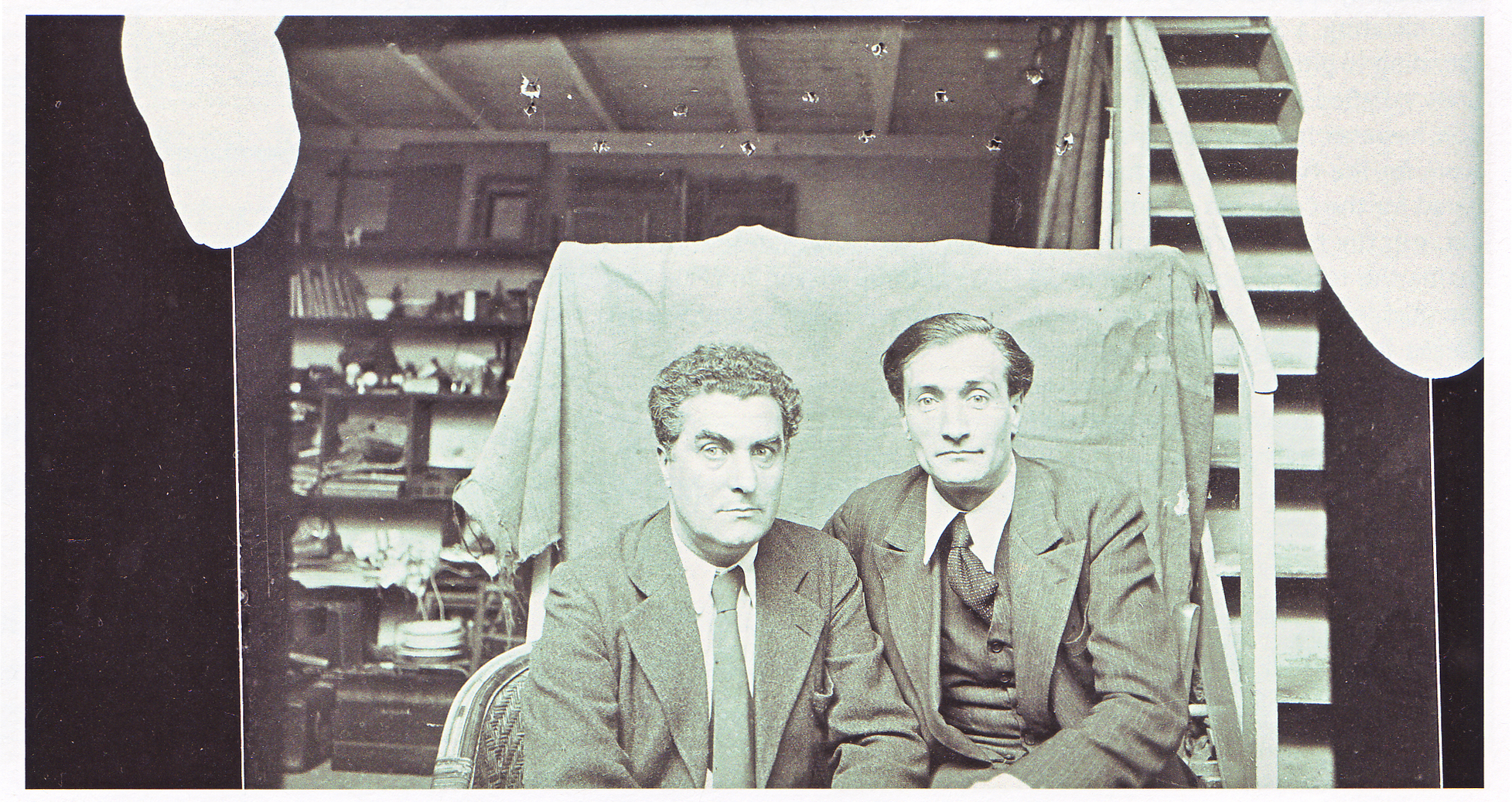
Edgard Varèse and Antonin Artaud 1933.
[fingers and pinholes are not mine]
Beyond the music and a panel discussion worth catching, there were also film screenings. I missed Mark Kidel’s early documentary, EV A Portrait, and only caught a few minutes of Frank Scheffer’s very recent documentary which takes its title from a never realised but ever-present all-encompassing notional work of Varèse’s; The One All Alone.
One of the impressive range of potential or partial collaborators that Varèse worked with towards this project was Antonin Artaud. Artaud is the king and fool of the 20th Century for me and it was the discovery of this image of him with Varèse, taken in 1933, just before both men began descents into physical and mental torments lasting a decade and half in each case, that really locked off my interest, passion, even enjoyment of Varèse [something comparable happened with Anne Carson]. A friend of Artaud’s is a friend of mine.
I was able only to see the beginning of Scheffer’s film in which Cage and Feldman discuss the figure who was a major influence or inspiration on and to both. It was one of the free screenings in the RFH and I’d love to be able to see it in full but as yet it has no distributor in the UK. Varèse is only very rarely performed in the UK so no surprise there, but he’s regularly performed and heard across Europe where the film has been screened but distribution is not yet finalised either.
This is the poster for it and below is a pdf of the other part of the flyer with contact details to the production company and a short director’s statement. I knew that the Varèse would be sold out -as it was- which is why I did something very strange for me and booked it months ago. However I had no idea whom it would be sold out to and the audience turned out to be pretty diverse in fact. I believe the panel’s description of teenage members of the NYO’s gradual but then real grasp and excited engagement with the music, but there were very few people under 25 in the audience.
However, the lack of appetite shown by all those really clever, super curious and on-the-ball distributors, festival organisers, British TV lunchboxes might be justified if only 17 people turned up [or, worse, the entire 117] but as it was it’s pitiful and repeats the offence of neglect that Varèse suffered throughout his extraordinary and difficult life.
The best way to encounter Varèse is live in performance, as I now know with indelible clarity, but a documentary is a foolproof introduction to the subject, the most easily negotiated threshold.
Press to enlarge
BIBLIO
Varèse: Astronomer in Sound by Malcolm Macdonald [Kahn & Averill 2002 pp 448]









 NOTES FROM A FRUITSTORE